
What Is a Board Certified Behavior Analyst? Complete Guide 2026

Table of Contents
- Understanding the Role of a Board Certified Behavior Analyst
- What Is a Board Certified Behavior Analyst? Certification and Scope
- Day-to-Day Responsibilities of a Board Certified Behavior Analyst
- How to Become a Board Certified Behavior Analyst
- Advanced Career Paths and Specializations for BCBAs
- Frequently Asked Questions About Board Certified Behavior Analysts
- Why BCBA Supervision Matters for Quality ABA Therapy
Understanding the Role of a Board Certified Behavior Analyst
A board certified behavior analyst (BCBA) is a graduate-level professional who has earned the most recognized credential in behavior analysis from the Behavior Analyst Certification Board (BACB). If you're wondering what is a BCBA, think of them as the expert who designs and oversees evidence-based interventions that help children build communication, independence, and daily living skills.
To become certified, every board certified behavior analyst must complete a master's degree in behavior analysis or a related field, accumulate supervised fieldwork hours, and pass the rigorous BCBA examination. Once certified, they adhere to strict ethical standards set by the BACB. This ensures your child receives care grounded in research and integrity.
Within ABA therapy, the BCBA's core responsibilities include conducting Functional Behavior Assessments (FBAs) to identify why behaviors occur, writing individualized treatment plans, supervising Registered Behavior Technicians (RBTs), and coaching parents and caregivers. By continuously monitoring progress and adjusting strategies, they ensure therapy remains tailored and effective. Our BCBAs work closely with each family to create a plan that fits your child's strengths and needs.
At Yes ABA Therapy, every program is overseen by a qualified BCBA who ensures that care is ethical, data-driven, and personalized. Finding a BCBA near you is a critical step toward meaningful support, and our team is ready to help. Through our BCBA-supervised programs, we provide ABA therapy for children no waitlist, so your child can start as soon as possible. Helping children thrive through personalized ABA therapy is at the heart of everything we do. Results may vary based on individual conditions and circumstances.
What Is a Board Certified Behavior Analyst? Certification and Scope
If you have been exploring ABA therapy options, you have likely asked yourself, what is a BCBA? A board certified behavior analyst, commonly called a BCBA, is a master’s level clinician who holds the leading credential in the field of applied behavior analysis. At Yes ABA Therapy, we rely on BCBA professionals to design every treatment plan, supervise clinical teams, and guide families toward meaningful, measurable progress. Think of your child’s BCBA as the architect of their personalized program — someone who combines scientific rigor with genuine compassion to help your child build communication, independence, and daily living skills.
How a Clinician Becomes a BCBA
The path to becoming a board-certified behavior analyst is demanding and highly structured, ensuring that every BCBA brings deep expertise to the families they serve. The Behavior Analyst Certification Board (BACB) establishes and enforces these standards. First, candidates must earn a qualifying master’s degree in behavior analysis, psychology, education, or a closely related field that includes specific BACB-verified coursework. Next, they complete extensive supervised practical experience — typically between 1,500 and 2,000 hours — working directly with clients under the mentorship of a qualified supervisor. Candidates then sit for the BACB certification examination, a comprehensive, rigorously maintained test that demonstrates mastery of behavior-analytic principles, ethical codes, and clinical applications. Full details on BCBA certification requirements are available through the BACB, including the most current experience standards, degree programs, and examination data.
What a BCBA Does: Scope of Practice
Once certified, a BCBA assumes broad clinical responsibilities that go well beyond sitting across from a child during a therapy session. Our BCBAs conduct initial and ongoing assessments, including functional behavior assessments and skills-based evaluations, to understand each child’s strengths, needs, and environmental influences. Using those insights, they write individualized treatment plans with measurable goals, select evidence-based intervention strategies, and continuously analyze data to refine programming. BCBAs also supervise Registered Behavior Technicians and Board Certified Assistant Behavior Analysts, ensuring that every hour of direct therapy remains aligned with the treatment plan and delivered with fidelity.
A BCBA’s work extends into multiple settings — including your home, your child’s school, community locations, and telehealth platforms — so skills are taught where they matter most. This flexibility supports generalization, helping children apply what they learn across different people, places, and routines. It is important to remember that while BCBA-directed ABA therapy has a strong evidence base, results may vary based on individual conditions and circumstances.
Why BCBA Expertise Matters in ABA Therapy
When a BCBA leads a child’s program, families gain access to a scientist-practitioner who makes real-time clinical decisions rooted in data rather than guesswork. Helping children thrive through personalized ABA therapy starts with having a qualified professional who can distinguish between a temporary obstacle and a need for a strategic program change. Our BCBAs meet regularly with caregivers to share progress updates, provide hands-on coaching, and adjust goals as your child develops new skills and faces new challenges. This close collaboration ensures that therapy stays relevant to your family’s priorities, from morning routines to social interactions and community participation. As we move into discussing how BCBAs put these responsibilities into practice, you will see how their day-to-day oversight shapes every aspect of your child’s ABA experience.
Day-to-Day Responsibilities of a Board Certified Behavior Analyst
Now that you understand the path to becoming a BCBA, let’s explore what a board certified behavior analyst does day to day. A BCBA is a master’s-level clinician certified by the Behavior Analyst Certification Board (BACB) who acts as the clinical lead for therapy. At Yes ABA Therapy, our BCBAs oversee every detail to deliver personalized, evidence-based care.
Assessment, Data Analysis, and Treatment Plan Development
A substantial part of our day involves assessment and data interpretation. We conduct Functional Behavior Assessments (FBAs) using direct observations, caregiver interviews, record reviews, and preference assessments to understand a child’s needs and motivations. We then graph and analyze behavioral data—spotting trends and calculating rates—to guide our decisions. This analysis forms the foundation of an individualized Behavior Intervention Plan (BIP) with measurable goals for skill acquisition and behavior reduction. According to Yes ABA Therapy, a board certified behavior analyst designs and oversees these plans to ensure they adapt as the child progresses.
Supervision, Training, and Interdisciplinary Collaboration
Supervision is a daily responsibility. We oversee Registered Behavior Technicians (RBTs), providing a minimum of 5% supervision of their direct service hours, conducting competency checks, and giving feedback to maintain high-quality, ethical implementation. We also prioritize caregiver training, teaching practical strategies that parents can use during everyday routines. Additionally, we collaborate with school IEP teams, speech therapists, and occupational therapists, aligning interventions across home, school, and therapy settings. In our practice, a board certified behavior analyst bridges these connections, promoting consistency.
Work Environments and Career Growth for BCBAs
Our BCBAs work wherever support is needed most. Common settings include in-home therapy, clinic sessions, school-based support, community outings, and telehealth. For families looking for a BCBA near them in Montgomery County, we offer services in Rockville, Bethesda, Silver Spring, and Gaithersburg. Many BCBAs deliver in-home ABA therapy in Montgomery County as part of a comprehensive, natural-environment treatment plan. Career advancement can lead to clinical supervisor, program director, or independent consultant roles, offering growth and specialization opportunities.
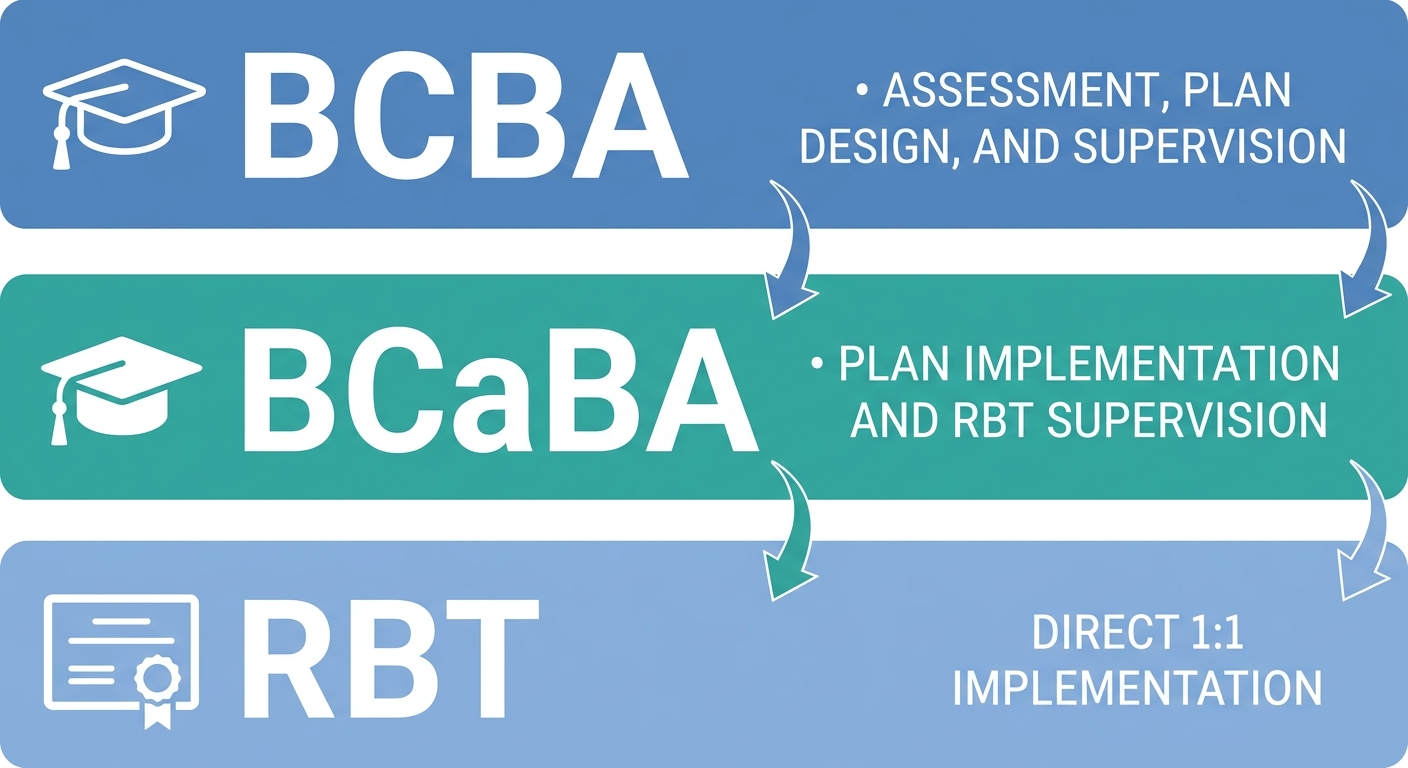
The Behavior Analyst Certification Board (BACB) outlines three certification levels. The table below compares education, supervision, and scope of practice.
| Role | Education Required | Supervision Responsibility | Scope of Practice | Certification Body |
|---|---|---|---|---|
| BCBA (Board Certified Behavior Analyst) | Master’s degree or higher in behavior analysis or related field | Supervises BCaBAs and RBTs; designs and oversees treatment plans | Full independent practice: assessment, design, implementation, evaluation | Behavior Analyst Certification Board (BACB) |
| BCaBA (Board Certified Assistant Behavior Analyst) | Bachelor’s degree in behavior analysis or related field | Works under supervision of a BCBA; may supervise RBTs | Limited independent practice: implements plans designed by BCBA | Behavior Analyst Certification Board (BACB) |
| RBT (Registered Behavior Technician) | High school diploma plus 40-hour training and competency assessment | Implements behavior plans under supervision of BCBA or BCaBA | Direct one-on-one implementation of skill acquisition and behavior reduction plans | Behavior Analyst Certification Board (BACB) |
This hierarchy ensures that every team member operates within their defined scope while delivering the highest standard of care. BCBAs provide strategic oversight that drives meaningful outcomes.
With this structure, families can appreciate the depth of expertise a BCBA brings. Understanding these responsibilities helps you see the value of BCBA-led therapy. Next, we’ll show you how to connect with a BCBA near you.
How to Become a Board Certified Behavior Analyst
Becoming a board certified behavior analyst requires graduate coursework, supervised fieldwork, and a certification exam. If you’re exploring what is a BCBA, it is the master’s-level credential for ABA practice. We outline the BACB requirements below.
Degree and Coursework Requirements
To earn board certified behavior analyst certification, you need a master’s or doctoral degree in behavior analysis, education, or psychology from an accredited university. The BACB requires completion of a Verified Course Sequence (VCS) that follows the BACB Task List – Fifth Edition. This curriculum covers measurement, ethics, behavior assessment, and intervention. Key details:
- A graduate degree from an accredited university is mandatory.
- Your program must include a BACB-approved VCS; the BACB maintains a directory of approved courses.
- Degree-holders may also qualify if they complete the coursework through a separate VCS after graduating.
- Many students complete their degrees in 2-3 years, with the VCS embedded or taken as a graduate certificate program.
Before applying, verify that your degree and coursework meet the current BACB standards to avoid delays.
Supervised Independent Fieldwork Hours
After completing your degree, you must accrue supervised fieldwork experience. The BACB offers two tracks: 1,500 hours under standard supervision or 1,000 hours under concentrated supervision. This must be supervised by a qualified BCBA and adhere to specific activity requirements:
- Standard track: 1,500 hours with at least 5% of time supervised monthly.
- Concentrated track: 1,000 hours with at least 10% supervision monthly and more rigorous documentation.
- At least 60% of the hours must be spent in behavior-analytic activities aligned with the BACB Task List.
- You can also qualify through an intensive practicum (750 hours in a BACB-accredited university program).
The fieldwork helps you apply what you learned in real-world settings, from conducting assessments to developing behavior intervention plans. We recommend starting your fieldwork early and keeping thorough documentation as required by your supervisor.
Passing the BCBA Certification Exam
Once coursework and fieldwork are complete, you must pass the BCBA certification exam. The computer-based test lasts four hours and includes 150 multiple-choice questions. The BACB structures the content around these areas:
- Foundations: measurement, experimental design, and behavior-analytic concepts.
- Applications: assessment, intervention, and behavior-change procedures.
- Professional and ethical conduct: ethical guidelines and supervisory skills.
A passing score is determined by the BACB’s psychometric process; the exam ensures candidates meet established competency standards. Preparation often includes reviewing the BACB Task List, completing practice exams, and studying with colleagues. We encourage you to download the BACB candidate handbook for detailed content outlines and study resources.
There are four recognized pathways to BCBA certification, allowing flexibility depending on your educational background and experience timeline. The following table compares the Traditional Coursework, Verified Course Sequence (VCS), Combined Experience/Practicum, and Intensive Practicum paths.
| Pathway | Degree Requirement | Supervised Experience Hours | Exam | Typical Timeline |
|---|---|---|---|---|
| Traditional Coursework Path | Master's or doctorate in behavior analysis or related field | 1,500 hours (standard) or 1,000 hours (concentrated) | BCBA certification exam | 2-3 years post-degree |
| Verified Course Sequence (VCS) Path | Master's or doctorate with BACB-approved VCS | 1,500 hours (standard) or 1,000 hours (concentrated) | BCBA certification exam | 1-2 years post-degree |
| Combined Experience/Practicum Path | Master's or doctorate in behavior analysis or related field | 2,000 hours (total combining practicum and fieldwork) | BCBA certification exam | 3-4 years post-degree |
| Intensive Practicum Path | Enrolled in BACB-accredited practicum program | 750 hours (concentrated practicum) | BCBA certification exam | 1-2 years concurrently with coursework |
After completing your chosen pathway and passing the exam, you can practice as a BCBA. Many newly certified behavior analysts choose to offer in-home ABA therapy for children with autism, designing individualized programs that help children build critical skills in familiar environments. At Yes ABA Therapy, our BCBA-led teams deliver compassionate, evidence-based care with no waitlist, accepting most major insurance plans. Results may vary based on individual conditions and circumstances. Please consult a qualified healthcare professional or licensed behavior analyst for personalized advice. We encourage you to verify current BACB requirements directly, as standards can evolve. If you’re searching for a BCBA near me, our intake team can help match you with a clinician in your area.
Advanced Career Paths and Specializations for BCBAs
For BCBAs looking to expand their impact, advanced career paths offer opportunities to apply behavior analysis across diverse settings. The board certified behavior analyst credential serves as a foundation, opening doors beyond direct one-on-one therapy into roles that shape entire programs and systems.
We know that early identification of autism signs — such as those described by the ABA Therapy Blog — lays the groundwork for effective intervention. Advanced BCBA roles, like Clinical Supervisor or Clinical Director, allow us to oversee teams, design comprehensive treatment plans, and ensure quality across services. These positions typically require years of experience and demonstrated leadership in Applied Behavior Analysis.
Another direction is Organizational Behavior Management (OBM). Here, board certified behavior analysts apply behavioral principles to improve workplace performance, staff training, and organizational systems. Pursuing OBM often involves additional coursework and supervised practice in business or industrial settings. Similarly, special education consulting enables BCBAs to collaborate with schools on inclusive practices, behavior supports, and curriculum adaptations.
For those drawn to academia, university teaching and research represent a natural progression. Faculty positions allow you to train the next generation of behavior analysts and contribute to the evidence base. The BCBA-D (doctoral) designation requires a PhD or equivalent and further supervised experience, but it opens doors to higher-level research and leadership roles. Additionally, independent consulting gives experienced BCBAs the flexibility to design behavior programs for agencies, families, or corporate clients.
As you consider BCBA opportunities near your community, remember that each advanced path calls for continued learning and specific experience hours. Whether you choose behavioral gerontology, early intervention direction, or clinical supervision, your career can evolve in meaningful ways. Understanding these options helps you plan next steps toward professional development and specialized training — topics we explore further in the resources that follow.
Frequently Asked Questions About Board Certified Behavior Analysts
Wondering about BCBAs? Here are answers to common questions we hear from families.
What is a BCBA? A board certified behavior analyst is a professional with a master's degree and board certification who designs and supervises individualized ABA therapy. We rely on BCBAs to create plans that help children thrive through personalized ABA therapy.
What does a BCBA do in in-home ABA therapy in Montgomery County? In our in-home sessions, a BCBA conducts functional behavior assessments and crafts tailored treatment plans. As Hashtag ABA Therapy notes, this approach ensures each child receives focused, evidence-based support in a familiar setting.
How do I find a BCBA near me? We offer in-home ABA therapy guided by experienced BCBAs across Montgomery County, including Rockville, Bethesda, and Silver Spring. Contact us to connect with a behavior analyst who understands your child's needs.
Results may vary based on individual conditions and circumstances.
Why BCBA Supervision Matters for Quality ABA Therapy
But supervision by a board certified behavior analyst (BCBA) is what truly sets quality ABA therapy apart. As the Behavior Analyst Certification Board outlines, BCBAs ensure treatment is evidence-based, individualized, and ethically sound. Our BCBA supervision guarantees that in-home ABA therapy for children in Montgomery County is tailored to each child’s needs and adjusted based on data, with a board certified behavior analyst overseeing progress and fidelity. This intensive oversight contrasts with unsupervised approaches, providing families with consistent, data-driven care. When you work with a BCBA near you through our services, your child receives support that may foster skill development and confidence. Helping children thrive through personalized ABA therapy is our commitment, and BCBA supervision is integrated into every therapy option we offer.
Resources
- Find In-Home ABA Therapy Providers in Montgomery County
- Explore In-Home ABA Therapy for Montgomery County Children
- Explore Person-Centered ABA Therapy in San Diego
- Get Expert In-Home ABA Therapy in Montgomery County
- Identify Early Autism Signs for Timely Intervention
- Explore Mindfulness Therapy Programs and Practitioners in San Diego
- Discover BCBA Certification Requirements for Behavior Analysts
