Understanding Social Skills Groups for Autism
For children with autism, social skills groups autism provide a structured, supportive environment to practice communication and social interaction. These small-group sessions are guided by a therapist and rooted in ABA principles, using natural environment teaching, where skills are practiced in realistic, everyday contexts, and peer modeling to build skills. Among social skills interventions autism, this group format uniquely allows children to learn from one another in real time.
Benefits of social skills groups include:
- Enhanced verbal and nonverbal communication
- Practicing turn-taking and sharing
- Building confidence to initiate and maintain friendships
Through autism social skills activities children enjoy, such as role-play and cooperative tasks, they become more comfortable navigating everyday interactions.
At Hidden Gems ABA Therapy, our ABA therapy services integrate social skills groups into both in-home and school-based programs. We deliver a personalized approach to treatment across our service areas, including in New Jersey and Arizona, so that social skills generalize to family, school, and community settings. We partner with families because ABA Therapy For Your Child’s Success depends on consistent, real-world practice. We also work side-by-side with families and educators to reinforce these skills at home and in the classroom. In the next section, we’ll explore specific strategies making these interventions engaging and effective.
What Are Social Skills Groups for Autism?
As an extension of our ABA therapy services, social skills groups autism provide structured opportunities for children with autism to practice social communication and interaction in a supportive environment. By blending evidence-based behavior analysis with targeted peer activities, these groups help children build essential social competencies in a systematic, measurable way.
Defining Social Skills Groups
Social skills groups autism are structured, therapist-led sessions designed to help children with autism spectrum disorder (ASD) develop effective communication and social interaction abilities. Unlike general play therapy, which may rely on unstructured peer time, these groups follow a systematic curriculum with clear goals, immediate feedback and ongoing data collection to track each child's progress. The structured nature of these sessions ensures that every interaction is a learning opportunity. Our social skills interventions autism programs use evidence-based techniques to teach turn-taking, initiating conversations and reading social cues—skills that are essential for building friendships and navigating school environments. By providing a supportive yet goal-oriented setting, these groups help children generalize their new abilities to everyday life, from the classroom to family gatherings. Our team collaborates closely with families to reinforce these skills in real-world contexts, ensuring lasting improvement.
The Role of ABA in Social Skills Group
At Hidden Gems ABA Therapy, we integrate behavior analysis and ABA overview principles into every session using a personalized approach that targets each child's unique needs. As defined by the Behavior Analyst Certification Board, applied behavior analysis is a natural science that examines how behavior is influenced by environmental events and consequences. In our social skills groups, therapists use positive reinforcement to encourage appropriate interactions, prompting techniques to guide turn-taking and shaping to gradually build complex social behaviors like initiating conversation. For example, when a child makes eye contact during a greeting, our team immediately provides verbal praise or a preferred item, reinforcing that skill so it becomes more likely to occur in the future. This consistent, data-driven method helps children acquire and maintain the social competencies needed for success at school and in the community. Through this comprehensive and collaborative approach, we empower families with the tools to support social growth outside of group sessions.
Age Considerations and Group Composition
Our social skills groups are organized by age and developmental stage to create the most effective learning environment. For preschool children, our autism social skills activities children can participate in include friendly cooperative games, sharing exercises and simple turn-taking routines. Elementary-age groups focus on conversation skills, friendship building and interpreting nonverbal cues, while teen groups work on advanced social navigation, including understanding sarcasm, managing peer pressure and maintaining reciprocal relationships. Each group is carefully matched so that participants share similar social challenges and communication styles, which maximizes engagement and growth. By matching composition to developmental readiness, we create a supportive peer community where children gain confidence and practice new skills in a natural, comfortable setting. This grouping ensures our social skills groups autism services meet each child's developmental needs. As children master these abilities, the next step is to explore the specific skills our curriculum emphasizes and the lasting benefits they provide.
How Social Skills Groups Help Children with Autism
At Hidden Gems ABA Therapy, we know that children with autism often need extra support to navigate the complexities of social interaction. Social skills groups for autism provide a safe and supportive environment where your child can practice these essential skills with guidance from trained professionals. These groups are an integral part of our comprehensive and collaborative approach, combining structured activities with evidence-based teaching to foster meaningful growth.
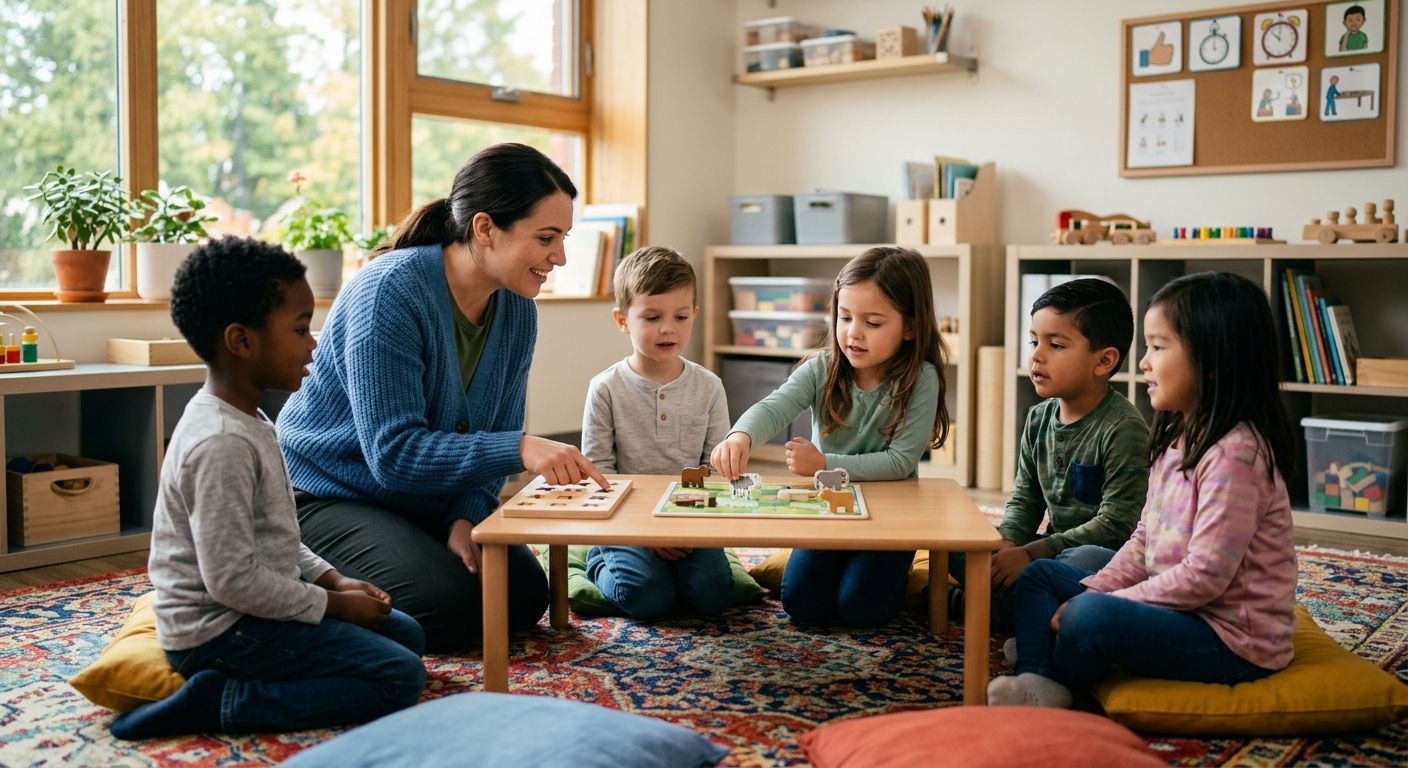
Social skills group session for children with autism, led by ABA therapist.
Key benefits of social skills groups for children with autism.
Each of these benefits is built on a foundation of applied behavior analysis (ABA), the scientific approach to understanding and changing behavior defined by the Behavior Analyst Certification Board (BACB). Now, let's explore how our groups turn that promise into real progress for your child.
Building Communication and Interaction Skills
Social skills groups focus on teaching children how to initiate and sustain conversations—a skill that many children with autism find challenging. Through structured activities, we target specific social communication skills such as taking turns, sharing, reading facial expressions and tone of voice, and engaging in joint attention. For example, a child might practice turn-taking during a board game in the group, learning to wait and respond to peers’ cues. Our sessions incorporate evidence-based ABA strategies like role-playing and video modeling, tools recommended by the BACB’s task lists to break down complex interactions into manageable steps. These autism social skills activities children can enjoy, from cooperative puzzles to simple conversation prompts, are woven into every session, making learning feel natural and rewarding.
Fostering Confidence and Independence
When children experience repeated success in a supportive, low-pressure setting, they begin to see themselves as capable communicators. That growing confidence reduces social anxiety and builds self-esteem—a direct outcome of our personalized approach to treatment. In our social skills groups for autism, we celebrate every small win, whether a child asks a peer a question or shares a toy without a prompt. These positive reinforcement loops encourage them to take more social risks. A child who once hesitated to speak might raise their hand to answer a question in school after several successful group sessions. By meeting each child at their own pace and using interventions that match their interests, we help them discover that connecting with others can feel safe and even joyful.
Generalizing Skills Beyond the Group
The true measure of success is whether your child can use these skills where they matter most—at home, in school, and in the community. That’s why our social skills groups are closely linked to our in-home & at-school ABA therapy. We coordinate with parents and teachers to practice the same targets across settings. For example, turn-taking practiced in group becomes part of family game night, while conversation initiation is reinforced during circle time at school with support from a behavior technician. Hidden Gems ABA Therapy’s commitment to generalization means every child’s program includes caregiver coaching and school-team coordination, so the skills from our groups become lasting, real-world habits. With these benefits in mind, you may be wondering how to get started.
Finding and Joining Social Skills Groups
Building on the importance of social skills development, finding the right social skills groups autism programs can make a meaningful difference for your child. The process of locating and enrolling in these groups doesn’t have to be overwhelming. This section walks you through where to look, what to expect during enrollment, and how group sessions can strengthen the progress your child is already making in one-on-one ABA therapy.
Where to Look for Social Skills Groups
Welcome to Hidden Gems ABA Therapy. When you are searching for social skills groups autism families can access, start with resources like your child’s school, local autism organizations, online directories, and referrals from your healthcare provider. Many school districts offer community-based groups, and trusted online platforms can connect you with programs in your area. For families located in New Jersey, North Carolina, Arizona, Colorado, and Utah, you can reach out directly to Hidden Gems ABA Therapy. Our team is ready to help you explore the group options we provide, all designed to blend seamlessly with your child’s existing therapy plan. These social skills interventions autism programs are built on evidence-based practices endorsed by the Behavior Analyst Certification Board (BACB) and are a natural extension of the ABA therapy your child may already receive.
The Enrollment and Assessment Process
Once you identify a social skills groups autism provider, the enrollment journey typically follows a clear, supportive path. At Hidden Gems ABA Therapy, the process begins with a simple phone or email inquiry, followed by insurance verification to confirm your coverage. A BCBA then conducts a thorough skills assessment, often in your home or at your child’s school, to understand your child’s strengths, communication style, and social goals. Based on this evaluation, our team places your child in a group that fits their age and developmental needs. We handle the scheduling and keep you informed every step of the way. After the assessment report is submitted to your insurance and service hours are authorized, your child can begin attending group sessions and benefiting from autism social skills activities children enjoy in a structured, supportive environment.
Integrating Group Work with In-Home ABA
Social skills groups autism programs work best when they complement the one-on-one ABA therapy your child receives at home or at school. Group sessions provide natural opportunities for peer interaction, giving your child a safe place to practice turn-taking, conversation, and cooperation—skills that can be hard to target in individual therapy alone. Our collaborative, family-focused approach helps ensure that what your child learns during in-home sessions generalizes to the group setting and beyond. As they engage in social skills interventions autism such as guided games and role-playing, they build confidence and apply their skills across different environments. This synergy between individual and group work reinforces progress and prepares your child for more independent social interactions in everyday life, setting the stage for the broader ABA therapy plan we’ll discuss next.
Best Practices for Social Skills Group Success
Age-Appropriate Activities and Interventions
Now that we’ve covered what social skills groups are, let’s explore best practices to ensure success. At Hidden Gems, our social skills groups autism sessions incorporate a variety of autism social skills activities children genuinely enjoy. For younger kids, we use turn-taking games like stacking blocks and emotion-matching card games that build foundational interaction skills. Older children and teens benefit from peer-led role-play scenarios and video modeling of conversation skills, where they watch and practice real-world interactions. These activities are selected based on each child’s Individualized Treatment Plan, ensuring that every group session is developmentally appropriate and engaging. We also use group social skills instruction that blends fun with token systems to reinforce positive participation. By embedding these behavioral research-backed strategies into our autism social skills programs, we make learning a natural part of play and build confidence for social situations like sharing and taking turns. Our BCBAs frequently introduce new games and peer-skills sessions to keep sessions fresh and responsive to each child’s current goals.
Parent Training and Home Reinforcement
Parent training is a vital part of social skills interventions autism because progress accelerates when families reinforce skills outside the therapy setting. At Hidden Gems, our caregiver training sessions teach practical strategies you can use at home and in the community. For instance, we guide families on creating a social story before playdates, giving your child a step-by-step preview of expected interactions. This simple carry-over technique helps bridge group learning with real-world social situations. We also provide coaching on using visual schedules and role-play rehearsal to increase comfort in social settings. Our team emphasizes positive reinforcement and consistent prompts that mirror what the child experiences in their social learning groups. This caregiver training is a core part of our comprehensive and collaborative approach, ensuring that progress doesn’t stop when the group session ends. By partnering closely with families, we create a supportive environment that encourages generalization of newly acquired skills.
Measuring Progress and Adjusting Goals
Effective social skills instruction relies on data-driven goals and ongoing monitoring. According to the Behavior Analyst Certification Board (BACB), data-based decision-making is essential for skill acquisition programs. At Hidden Gems, our BCBAs track each child’s progress using behavioral logs and token-system data, then review these measures regularly. When a child masters a target—such as initiating greetings or sharing—we adjust the plan to introduce the next developmentally appropriate skill. This quarterly review process aligns with our personalized approach to treatment, ensuring that every goal stays relevant and challenging without causing frustration. Through careful data tracking and collaboration, our social-skills training groups evolve to meet each child where they are. These practices help children build lasting social connections.
Supporting Your Child's Social Development with ABA Therapy
Building on the foundational skills addressed in ABA therapy, our programs include structured social skills groups for autism. During social skills training, we break down interactions like turn-taking and initiating conversations into simple, teachable steps. Your child practices these skills in real-world settings, whether at home or at school, so they can generalize them across environments. Our therapists use positive reinforcement to encourage social behaviors, making each success a building block for confidence.
We design individualized goals based on a comprehensive assessment completed by a Board Certified Behavior Analyst. This personalized approach ensures your child works on the specific social skills they need most, from joining play activities to maintaining friendships. Parent and caregiver involvement is essential; we equip you with autism social skills activities for children to use during daily routines, reinforcing progress between sessions.
By embedding social skills interventions for autism into natural settings, we help your child navigate social situations with greater ease. Our in-home and at-school therapy model across New Jersey, North Carolina, Arizona, Colorado, and Utah creates a consistent support system. Alongside social development, ABA therapy also targets communication and daily living skills, providing a well-rounded foundation for lifelong success.
Resources

.avif)

.avif)


Table of Contents
Understanding Social Skills Groups for Autism
For children with autism, social skills groups autism provide a structured, supportive environment to practice communication and social interaction. These small-group sessions are guided by a therapist and rooted in ABA principles, using natural environment teaching, where skills are practiced in realistic, everyday contexts, and peer modeling to build skills. Among social skills interventions autism, this group format uniquely allows children to learn from one another in real time.
Benefits of social skills groups include:
Through autism social skills activities children enjoy, such as role-play and cooperative tasks, they become more comfortable navigating everyday interactions.
At Hidden Gems ABA Therapy, our ABA therapy services integrate social skills groups into both in-home and school-based programs. We deliver a personalized approach to treatment across our service areas, including in New Jersey and Arizona, so that social skills generalize to family, school, and community settings. We partner with families because ABA Therapy For Your Child’s Success depends on consistent, real-world practice. We also work side-by-side with families and educators to reinforce these skills at home and in the classroom. In the next section, we’ll explore specific strategies making these interventions engaging and effective.
What Are Social Skills Groups for Autism?
As an extension of our ABA therapy services, social skills groups autism provide structured opportunities for children with autism to practice social communication and interaction in a supportive environment. By blending evidence-based behavior analysis with targeted peer activities, these groups help children build essential social competencies in a systematic, measurable way.
Defining Social Skills Groups
Social skills groups autism are structured, therapist-led sessions designed to help children with autism spectrum disorder (ASD) develop effective communication and social interaction abilities. Unlike general play therapy, which may rely on unstructured peer time, these groups follow a systematic curriculum with clear goals, immediate feedback and ongoing data collection to track each child's progress. The structured nature of these sessions ensures that every interaction is a learning opportunity. Our social skills interventions autism programs use evidence-based techniques to teach turn-taking, initiating conversations and reading social cues—skills that are essential for building friendships and navigating school environments. By providing a supportive yet goal-oriented setting, these groups help children generalize their new abilities to everyday life, from the classroom to family gatherings. Our team collaborates closely with families to reinforce these skills in real-world contexts, ensuring lasting improvement.
The Role of ABA in Social Skills Group
At Hidden Gems ABA Therapy, we integrate behavior analysis and ABA overview principles into every session using a personalized approach that targets each child's unique needs. As defined by the Behavior Analyst Certification Board, applied behavior analysis is a natural science that examines how behavior is influenced by environmental events and consequences. In our social skills groups, therapists use positive reinforcement to encourage appropriate interactions, prompting techniques to guide turn-taking and shaping to gradually build complex social behaviors like initiating conversation. For example, when a child makes eye contact during a greeting, our team immediately provides verbal praise or a preferred item, reinforcing that skill so it becomes more likely to occur in the future. This consistent, data-driven method helps children acquire and maintain the social competencies needed for success at school and in the community. Through this comprehensive and collaborative approach, we empower families with the tools to support social growth outside of group sessions.
Age Considerations and Group Composition
Our social skills groups are organized by age and developmental stage to create the most effective learning environment. For preschool children, our autism social skills activities children can participate in include friendly cooperative games, sharing exercises and simple turn-taking routines. Elementary-age groups focus on conversation skills, friendship building and interpreting nonverbal cues, while teen groups work on advanced social navigation, including understanding sarcasm, managing peer pressure and maintaining reciprocal relationships. Each group is carefully matched so that participants share similar social challenges and communication styles, which maximizes engagement and growth. By matching composition to developmental readiness, we create a supportive peer community where children gain confidence and practice new skills in a natural, comfortable setting. This grouping ensures our social skills groups autism services meet each child's developmental needs. As children master these abilities, the next step is to explore the specific skills our curriculum emphasizes and the lasting benefits they provide.
How Social Skills Groups Help Children with Autism
At Hidden Gems ABA Therapy, we know that children with autism often need extra support to navigate the complexities of social interaction. Social skills groups for autism provide a safe and supportive environment where your child can practice these essential skills with guidance from trained professionals. These groups are an integral part of our comprehensive and collaborative approach, combining structured activities with evidence-based teaching to foster meaningful growth.
Social skills group session for children with autism, led by ABA therapist.
Key benefits of social skills groups for children with autism.
Each of these benefits is built on a foundation of applied behavior analysis (ABA), the scientific approach to understanding and changing behavior defined by the Behavior Analyst Certification Board (BACB). Now, let's explore how our groups turn that promise into real progress for your child.
Building Communication and Interaction Skills
Social skills groups focus on teaching children how to initiate and sustain conversations—a skill that many children with autism find challenging. Through structured activities, we target specific social communication skills such as taking turns, sharing, reading facial expressions and tone of voice, and engaging in joint attention. For example, a child might practice turn-taking during a board game in the group, learning to wait and respond to peers’ cues. Our sessions incorporate evidence-based ABA strategies like role-playing and video modeling, tools recommended by the BACB’s task lists to break down complex interactions into manageable steps. These autism social skills activities children can enjoy, from cooperative puzzles to simple conversation prompts, are woven into every session, making learning feel natural and rewarding.
Fostering Confidence and Independence
When children experience repeated success in a supportive, low-pressure setting, they begin to see themselves as capable communicators. That growing confidence reduces social anxiety and builds self-esteem—a direct outcome of our personalized approach to treatment. In our social skills groups for autism, we celebrate every small win, whether a child asks a peer a question or shares a toy without a prompt. These positive reinforcement loops encourage them to take more social risks. A child who once hesitated to speak might raise their hand to answer a question in school after several successful group sessions. By meeting each child at their own pace and using interventions that match their interests, we help them discover that connecting with others can feel safe and even joyful.
Generalizing Skills Beyond the Group
The true measure of success is whether your child can use these skills where they matter most—at home, in school, and in the community. That’s why our social skills groups are closely linked to our in-home & at-school ABA therapy. We coordinate with parents and teachers to practice the same targets across settings. For example, turn-taking practiced in group becomes part of family game night, while conversation initiation is reinforced during circle time at school with support from a behavior technician. Hidden Gems ABA Therapy’s commitment to generalization means every child’s program includes caregiver coaching and school-team coordination, so the skills from our groups become lasting, real-world habits. With these benefits in mind, you may be wondering how to get started.
Finding and Joining Social Skills Groups
Building on the importance of social skills development, finding the right social skills groups autism programs can make a meaningful difference for your child. The process of locating and enrolling in these groups doesn’t have to be overwhelming. This section walks you through where to look, what to expect during enrollment, and how group sessions can strengthen the progress your child is already making in one-on-one ABA therapy.
Where to Look for Social Skills Groups
Welcome to Hidden Gems ABA Therapy. When you are searching for social skills groups autism families can access, start with resources like your child’s school, local autism organizations, online directories, and referrals from your healthcare provider. Many school districts offer community-based groups, and trusted online platforms can connect you with programs in your area. For families located in New Jersey, North Carolina, Arizona, Colorado, and Utah, you can reach out directly to Hidden Gems ABA Therapy. Our team is ready to help you explore the group options we provide, all designed to blend seamlessly with your child’s existing therapy plan. These social skills interventions autism programs are built on evidence-based practices endorsed by the Behavior Analyst Certification Board (BACB) and are a natural extension of the ABA therapy your child may already receive.
The Enrollment and Assessment Process
Once you identify a social skills groups autism provider, the enrollment journey typically follows a clear, supportive path. At Hidden Gems ABA Therapy, the process begins with a simple phone or email inquiry, followed by insurance verification to confirm your coverage. A BCBA then conducts a thorough skills assessment, often in your home or at your child’s school, to understand your child’s strengths, communication style, and social goals. Based on this evaluation, our team places your child in a group that fits their age and developmental needs. We handle the scheduling and keep you informed every step of the way. After the assessment report is submitted to your insurance and service hours are authorized, your child can begin attending group sessions and benefiting from autism social skills activities children enjoy in a structured, supportive environment.
Integrating Group Work with In-Home ABA
Social skills groups autism programs work best when they complement the one-on-one ABA therapy your child receives at home or at school. Group sessions provide natural opportunities for peer interaction, giving your child a safe place to practice turn-taking, conversation, and cooperation—skills that can be hard to target in individual therapy alone. Our collaborative, family-focused approach helps ensure that what your child learns during in-home sessions generalizes to the group setting and beyond. As they engage in social skills interventions autism such as guided games and role-playing, they build confidence and apply their skills across different environments. This synergy between individual and group work reinforces progress and prepares your child for more independent social interactions in everyday life, setting the stage for the broader ABA therapy plan we’ll discuss next.
Best Practices for Social Skills Group Success
Age-Appropriate Activities and Interventions
Now that we’ve covered what social skills groups are, let’s explore best practices to ensure success. At Hidden Gems, our social skills groups autism sessions incorporate a variety of autism social skills activities children genuinely enjoy. For younger kids, we use turn-taking games like stacking blocks and emotion-matching card games that build foundational interaction skills. Older children and teens benefit from peer-led role-play scenarios and video modeling of conversation skills, where they watch and practice real-world interactions. These activities are selected based on each child’s Individualized Treatment Plan, ensuring that every group session is developmentally appropriate and engaging. We also use group social skills instruction that blends fun with token systems to reinforce positive participation. By embedding these behavioral research-backed strategies into our autism social skills programs, we make learning a natural part of play and build confidence for social situations like sharing and taking turns. Our BCBAs frequently introduce new games and peer-skills sessions to keep sessions fresh and responsive to each child’s current goals.
Parent Training and Home Reinforcement
Parent training is a vital part of social skills interventions autism because progress accelerates when families reinforce skills outside the therapy setting. At Hidden Gems, our caregiver training sessions teach practical strategies you can use at home and in the community. For instance, we guide families on creating a social story before playdates, giving your child a step-by-step preview of expected interactions. This simple carry-over technique helps bridge group learning with real-world social situations. We also provide coaching on using visual schedules and role-play rehearsal to increase comfort in social settings. Our team emphasizes positive reinforcement and consistent prompts that mirror what the child experiences in their social learning groups. This caregiver training is a core part of our comprehensive and collaborative approach, ensuring that progress doesn’t stop when the group session ends. By partnering closely with families, we create a supportive environment that encourages generalization of newly acquired skills.
Measuring Progress and Adjusting Goals
Effective social skills instruction relies on data-driven goals and ongoing monitoring. According to the Behavior Analyst Certification Board (BACB), data-based decision-making is essential for skill acquisition programs. At Hidden Gems, our BCBAs track each child’s progress using behavioral logs and token-system data, then review these measures regularly. When a child masters a target—such as initiating greetings or sharing—we adjust the plan to introduce the next developmentally appropriate skill. This quarterly review process aligns with our personalized approach to treatment, ensuring that every goal stays relevant and challenging without causing frustration. Through careful data tracking and collaboration, our social-skills training groups evolve to meet each child where they are. These practices help children build lasting social connections.
Supporting Your Child's Social Development with ABA Therapy
Building on the foundational skills addressed in ABA therapy, our programs include structured social skills groups for autism. During social skills training, we break down interactions like turn-taking and initiating conversations into simple, teachable steps. Your child practices these skills in real-world settings, whether at home or at school, so they can generalize them across environments. Our therapists use positive reinforcement to encourage social behaviors, making each success a building block for confidence.
We design individualized goals based on a comprehensive assessment completed by a Board Certified Behavior Analyst. This personalized approach ensures your child works on the specific social skills they need most, from joining play activities to maintaining friendships. Parent and caregiver involvement is essential; we equip you with autism social skills activities for children to use during daily routines, reinforcing progress between sessions.
By embedding social skills interventions for autism into natural settings, we help your child navigate social situations with greater ease. Our in-home and at-school therapy model across New Jersey, North Carolina, Arizona, Colorado, and Utah creates a consistent support system. Alongside social development, ABA therapy also targets communication and daily living skills, providing a well-rounded foundation for lifelong success.
Resources