
.avif)

.avif)


Table of Contents
Understanding Low Functioning Autism
Within the autism spectrum, the term low functioning autism is informally used to describe individuals who require very substantial support in daily life. Clinically, this presentation aligns most closely with Level 3 autism, a diagnostic classification that indicates a need for intensive, around-the-clock care and assistance.
Core characteristics of this profile include severe deficits in both verbal and nonverbal communication – many individuals are minimally verbal or non-speaking – alongside very limited initiation of social interaction. There are often frequent, intense repetitive behaviors that significantly interfere with functioning, and a co-occurring intellectual disability is common. Professionals now refer to this as 'Level 3 autism' or severe autism, as the label 'low functioning' is considered by many to be outdated and does not capture an individual's potential for growth.
We understand that a diagnosis of severe autism can feel overwhelming for families. However, evidence-based support is available. Applied Behavior Analysis, or ABA, is a data-driven approach with proven efficacy for individuals across the spectrum. Understanding the ABA therapy meaning helps families see how structured interventions can build essential skills. Our personalized approach to treatment is overseen by a Board Certified Behavior Analyst who designs a tailor-made plan to target communication, daily living skills, and the reduction of behaviors that pose a risk to the individual’s safety or well-being.
At Hidden Gems ABA, we deliver in-home & at-school ABA therapy, embedding interventions directly into the environments where skills are needed most. In the next section, we explore how ABA therapy can be structured for these unique needs.
Defining Low Functioning Autism and Its Characteristics
When discussing the autism spectrum, severity and support needs vary widely. The term "low functioning autism" is an informal descriptor used to describe individuals on the spectrum who require very substantial support in daily life. It is important to clarify that this is not a formal clinical diagnosis recognized in the Diagnostic and Statistical Manual of Mental Disorders (DSM-5). Rather, it is a label often applied to those with the most intense challenges, overlapping significantly with what clinicians formally categorize as Level 3 autism—the highest support tier. For families who encounter these terms in medical reports or educational plans, behavior analysis international resources can provide further evidence-based guidance on understanding these classifications.
Individuals described as having severe autism or low functioning autism typically present with pronounced communication and behavioral characteristics. They are often non-verbal or minimally verbal, relying on alternative methods such as picture exchange systems or augmentative communication devices to express basic needs. Repetitive and self-stimulatory behaviors—like hand-flapping, rocking, or spinning objects—are frequent and intense. A high risk of self-injurious behaviors, such as head-banging or biting, differentiates this profile from milder forms of the spectrum. Sensory sensitivities are magnified, leading to extreme distress in overstimulating environments, and any change in routine can trigger significant emotional dysregulation.
These challenges translate into a requirement for consistent and structured assistance with activities of daily living. Support needs extend across dressing, feeding, toileting, and personal safety, often necessitating supervision around the clock. Therapeutic interventions focus on building functional communication skills, reducing self-injurious behaviors, and increasing tolerance for daily routines. The U.S. Department of Education provides critical guidance, ensuring that children with the most severe forms of autism have access to individualized educational plans and accommodations under federal law. At Hidden Gems ABA, we integrate these principles into our family-centered model, where caregiver training and data-driven strategies help children with high-support needs make measurable gains in familiar settings like home and school.
To clarify the terminology families often encounter, the comparison below distinguishes three overlapping terms used to describe autism with the greatest support needs.
The following table highlights key differences across clinical recognition, support intensity, communication ability, and behavioral presentation.
| Term | Clinical Recognition | Support Needs | Communication | Behavioral Presentation |
|---|---|---|---|---|
| Low Functioning Autism | Not a formal diagnosis; informal descriptor | Very high—requires substantial daily support | Often non-verbal or minimally verbal | Frequent repetitive behaviors, possible self-injury |
| Severe Autism | Common descriptive term; no separate DSM code | High—needs consistent, structured assistance | Minimal or no spoken language; uses alternative methods | Intense repetitive behaviors; sensory overload common |
| Level 3 Autism | Formal DSM-5 severity level; highest support tier | Very high—requires 24/7 support in many cases | Severe deficits in verbal and non-verbal communication | Marked repetitive behaviors, extreme distress to change |
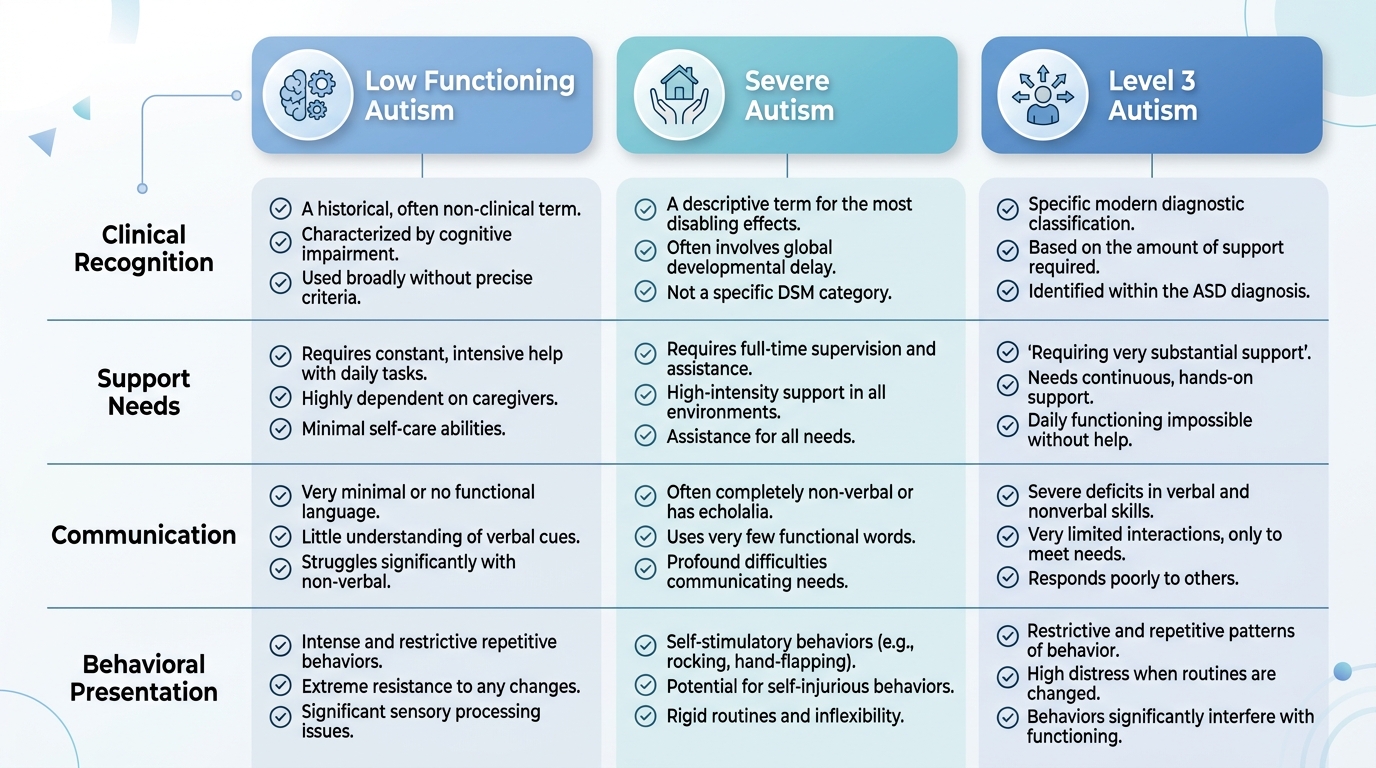
Comparison of autism classification terms and characteristics
This visual comparison reinforces how these terms overlap in describing severe autism profiles, yet differ in formal status and clinical precision. Understanding these nuances is essential when reviewing evaluation reports or advocating for appropriate services.
Ultimately, recognizing the characteristics associated with low functioning autism—whether called severe autism or Level 3 autism—allows families and professionals to align on the right interventions. By targeting the specific communication, behavioral, and daily living needs that define this presentation, comprehensive ABA therapy can help build foundational skills and improve quality of life. In the next section, we will explore how ABA interventions are tailored specifically for children with the most significant support requirements.
Differences Between Low, High, and Severe Autism
As we explore the diversity of the autism spectrum, it becomes important to understand how support needs vary across different severity levels. The terms low functioning autism and high functioning autism are often used by families to describe these differences, though clinically, the DSM-5 uses levels to indicate the amount of support an individual requires. The table below summarizes the key distinctions between what are commonly referred to as low functioning and high functioning autism.
| Domain | Low Functioning Autism (Level 3) | High Functioning Autism (Level 1) |
|---|---|---|
| Communication | Minimal or absent spoken language; may use AAC devices | Fluent speech but pragmatic difficulties; may seem awkward |
| Social Interaction | Little interest in peers; may not initiate interaction | Desires friends but struggles with social cues and conversation |
| Repetitive Behaviors | Frequent, intense, and disruptive; may be self-injurious | Milder, may be channeled into focused interests |
| Sensory Sensitivities | Extreme hyper/hyposensitivity; may cause meltdowns | Moderate sensitivities; can often self-regulate |
| Support Needs | Very substantial support across all daily activities | Require support but can function independently in many areas |
This table highlights a wide gulf in functional abilities, but it is crucial to remember that these are not discrete categories. The spectrum is continuous, and each individual possesses a unique constellation of strengths and challenges. The term severe autism is often used interchangeably with Level 3 in lay conversations, reflecting the intensity of support required.
Comparing Symptom Profiles
When we compare individuals with low functioning autism to those with high functioning autism, the most immediate difference is often in communication. A person with Level 3 autism may be nonverbal or have very limited speech, relying on alternative and augmentative communication (AAC) devices to express basic needs. In contrast, an individual with high functioning autism typically has fluent speech but struggles profoundly with the social use of language. They may speak with an unusual tone, have difficulty maintaining a back-and-forth conversation, or misinterpret figurative language, making social connection challenging despite their strong vocabulary.
Behavioral patterns also differ markedly between these profiles. For an individual with significant support needs, repetitive behaviors are frequently intense and disruptive, such as prolonged hand-flapping, rocking, or even self-injurious actions like head-banging. These behaviors are often a response to overwhelming sensory input. An individual with a higher-dependency profile may experience extreme hyper- or hyposensitivity to sound, light, or touch, which can quickly trigger a meltdown. Conversely, while a person with Level 1 autism also exhibits repetitive behaviors, these are often channeled into intense, focused interests, and their sensory sensitivities are typically milder, allowing them to learn self-regulation strategies with proper coaching.
Daily Life with Level 3 Autism
The daily life of an individual with severe autism revolves around managing profound autism traits that affect all areas of functioning. These individuals require very substantial support for basic self-care, including dressing, eating, and toileting. Safety is a constant, primary concern, as limited communication skills can leave them unable to report pain, illness, or danger. At Hidden Gems ABA, we see firsthand how a comprehensive and collaborative approach involving intensive in-home therapy can build fundamental communication and safety skills, but the need for 24/7 supervision often remains. The intensity of their repetitive behaviors, which can be self-injurious, necessitates constant environmental management and intervention by trained caregivers.
Socially, a person with this higher-dependency profile is often disconnected from peers. They rarely initiate interactions and may seem unaware of others in their environment. For families, navigating the school system requires significant advocacy. Families of children with Level 3 autism often rely on special education federal resources to ensure appropriate accommodations like a one-on-one aide or placement in a specialized classroom. Our school-based ABA services are designed to integrate with these educational plans, targeting classroom-ready skills to improve the child’s ability to learn and function safely alongside others.
Diagnostic Considerations
Clinicians differentiate between severity levels on the autism spectrum based on the degree of support required, not merely the presence of symptoms. According to the DSM-5 criteria, a diagnosis of Level 3 autism indicates a need for very substantial support. This is determined by critically evaluating communication ability, which for Level 3 is marked by severe deficits with minimal response to social overtures, and behavioral flexibility, where an extreme difficulty with change causes great distress. It is important to clarify that the terms low functioning and high functioning are not clinical diagnoses but descriptive labels often used to communicate a person's general support tier to non-specialists.
At Hidden Gems ABA, our BCBA-led assessment process measures a child’s unique baseline across dozens of functional domains to craft a data-driven treatment plan. For a child newly diagnosed with Level 3 autism, this plan will target foundational skills, heavily emphasizing the principles of ABA to encourage any form of functional communication and reduce self-injurious behaviors. The goal of therapy is never to change someone’s diagnostic level but to help them reach their full individual potential. Our personalized approach to treatment focuses on incremental, measurable progress—celebrating gains in joint attention, a successful request using a picture card, or a reduction in crisis episodes—all of which dramatically improve quality of life. Recognizing where a child falls on this spectrum guides the selection of effective therapies, which we discuss in the following sections.
Please consult with a healthcare professional or Board Certified Behavior Analyst (BCBA) for personalized advice. This information is for educational purposes and is not a substitute for professional medical or behavioral-health advice. Results may vary based on individual circumstances.
Evidence-Based Treatments and Home Support Strategies
Children with low functioning autism face significant challenges in communication, social interaction, and daily living skills that require comprehensive, evidence-based solutions. At Hidden Gems ABA Therapy, we understand that every child with severe autism has unique strengths and needs, which is why we deliver a personalized approach to treatment that combines proven therapeutic methods with practical home support. For families raising children with level 3 autism, accessing the right combination of professional services and learning strategies to reinforce progress at home can transform daily life and unlock meaningful developmental gains. Our comprehensive and collaborative approach ensures that every intervention is data-driven, supervised by Board Certified Behavior Analysts (BCBAs), and designed to generalize skills across settings.
The following table compares major therapy options commonly recommended for children with low functioning autism, highlighting how each approach addresses core challenges.
| Therapy Type | Focus Area | Key Benefits for Low Functioning Autism | Typical Setting |
|---|---|---|---|
| Applied Behavior Analysis (ABA) | Communication, social skills, daily living, behavior reduction | Builds foundational skills through reinforcement; reduces challenging behaviors; generalizes skills across settings | In-home, school-based, clinic; highly individualized |
| Speech-Language Therapy | Verbal and non-verbal communication, AAC use, swallowing | Develops functional communication; supports AAC devices; addresses oral-motor issues | Clinic, school, in-home (less common) |
| Occupational Therapy (OT) | Sensory processing, fine motor, self-care, regulation | Reduces sensory overload; improves daily living skills; enhances self-regulation | Clinic, school, in-home |
| Social Skills Groups | Peer interaction, turn-taking, conversation, friendship | Provides structured peer practice; increases social motivation; builds confidence in group settings | In-home, group settings, clinics |
Each of these therapies plays a distinct role in a comprehensive treatment plan for children with low functioning autism. ABA therapy, grounded in decades of behavior analysis research, serves as the cornerstone for building foundational skills and reducing challenging behaviors through systematic reinforcement. When combined with speech-language therapy and occupational therapy, children receive coordinated support that addresses communication, sensory, and motor development simultaneously.
ABA Therapy Approaches
Applied Behavior Analysis (ABA) therapy is the most extensively researched and widely recommended intervention for individuals with severe autism. Our in-home & at-school ABA therapy programs are designed and supervised by BCBAs who create individualized treatment plans targeting communication, social, and adaptive skills specific to each child’s developmental level. For children with level 3 autism, we focus on breaking complex skills into manageable, teachable components using methods such as Discrete Trial Training (DTT) for structured skill acquisition and Natural Environment Teaching (NET) to promote generalization into everyday routines.
Behavior reduction is another critical component, where we identify the function of challenging behaviors and teach alternative, functional communication responses. Whether a child is learning to request basic needs, tolerate transitions, or engage in cooperative play, our data-driven approach ensures that progress is measurable and interventions are adjusted based on ongoing assessment. All treatment plans prioritize caregiver training so that parents and family members can reinforce skills consistently, extending therapeutic gains beyond scheduled sessions into daily life. ABA Therapy For Your Child's Success means meeting each child where they are and building a foundation for lasting independence.
Communication Interventions
Communication deficits are among the most impactful challenges for children with low functioning autism, and addressing them requires a multi-faceted approach. Speech-language therapy targets both verbal production and receptive language, helping children articulate sounds, form words, and understand spoken instructions. For minimally verbal or non-verbal children, augmentative and alternative communication (AAC) systems — including picture exchange communication systems (PECS), speech-generating devices, and tablet-based applications — provide essential tools for functional expression. As discussed in our speech therapy blog, these interventions are most effective when integrated with ABA strategies that reinforce communication attempts through prompting, shaping, and positive reinforcement. Hidden Gems ABA Therapy collaborates with speech-language pathologists to ensure that communication goals are aligned across therapeutic settings, supporting children in expressing wants, needs, and social initiations at home, in school, and within the community.
Supporting Your Child at Home
Translating therapeutic progress into home environments is essential for children with severe autism. We coach families to establish structured routines that provide predictability, reducing anxiety and creating opportunities for skill practice. Visual schedules — using pictures or written steps to outline daily activities — empower children to navigate transitions with greater independence. Positive reinforcement is a cornerstone strategy: by identifying what motivates a child and delivering praise, tokens, or preferred items immediately after desired behaviors, parents can strengthen communication attempts, cooperation, and self-help skills. Simple adjustments such as designating quiet spaces for sensory regulation, breaking tasks into smaller steps, and modeling social interactions during play can reinforce what children learn in ABA and related therapies throughout their daily lives.
Available Services and Support Networks
Families raising children with level 3 autism benefit from accessing a broad network of services. Early intervention programs provide critical developmental support for children under age three, often including speech therapy, occupational therapy, and ABA. School-based services, protected under the Individuals with Disabilities Education Act (IDEA), offer individualized education plans (IEPs) tailored to each student's needs. Respite care provides temporary relief for caregivers, reducing family stress while ensuring children remain in safe, supportive environments. Parent training programs equip families with practical behavior management and communication strategies. Social skills groups, a key offering at Hidden Gems ABA Therapy, provide structured peer interaction opportunities where children practice turn-taking, sharing, and conversation initiation under therapist guidance. Learn more about the benefits social skills groups offer through our FAQ resource, which explains how these groups build social motivation and self-confidence in a controlled, supportive setting.
Disclaimer: Results may vary based on individual circumstances. Please consult with a healthcare professional or Board Certified Behavior Analyst (BCBA) for personalized advice. Information on this site is for educational purposes and is not a substitute for professional medical or behavioral-health advice.
Long-Term Improvement and Multi-Disciplinary Care
The impact of early ABA therapy extends far beyond the initial years of treatment, particularly for children with low functioning autism. Early and intensive intervention provides the best opportunity for meaningful, lasting progress. When therapy begins during the critical developmental window, we often see significant gains that can reshape a child's entire trajectory.
The following table compares the potential long-term outcomes of early intervention with those of later intervention, illustrating the importance of beginning services as soon as possible.
| Outcome Area | Early Intervention (Ages 2-5) | Later Intervention (Age 7+) |
|---|---|---|
| Communication Gains | Higher likelihood of developing functional spoken language or AAC use | More resistant to change; progress possible but slower |
| Adaptive Skills | Foundation for self-care and independence can be built early | Requires intensive scaffolding to overcome entrenched habits |
| Behavior Reduction | Challenging behaviors more malleable; early reinforcement shapes alternatives | Behaviors may be more ingrained; requires consistent behavior plans |
| Family Training Impact | Caregiver training early leads to better generalization across settings | Family training still effective but may need to address longer history of coping patterns |
As our internal outcomes data shows, children who begin therapy between ages two and five build foundational adaptive skills more readily. For a child with severe autism (sometimes classified as level 3 autism), these early years are crucial for establishing communication patterns, whether through spoken language or an augmentative system. Caregiver training during this period is equally vital, as it empowers families to reinforce new skills across all environments, from the home to the community.
We believe a comprehensive and collaborative approach is essential for holistic improvement. Beyond one-on-one ABA, multi-disciplinary care that includes speech-language pathologists and occupational therapists addresses a child's complete profile of needs. Our social skills groups autism definition incorporate peer interaction into the treatment model, providing structured opportunities to practice conversation and friendship-building. This personalized approach to treatment ensures that progress is generalized and sustained over time, creating the best foundation for lifelong success. To begin your child's journey, we encourage you to reach out and schedule an assessment with one of our Board Certified Behavior Analysts (BCBAs).
Results may vary based on individual circumstances. Please consult with a healthcare professional or Board Certified Behavior Analyst (BCBA) for personalized advice.
Frequently Asked Questions About Low Functioning Autism
What is low functioning autism?
Low functioning autism is a term used to describe severe autism or Level 3 autism, where individuals require substantial support with communication and daily living. Children with this diagnosis often have limited verbal skills and significant behavioral challenges, making early intervention essential.
How is low functioning autism different from other autism spectrum levels?
Unlike milder forms, low functioning autism—or severe autism—involves profound social difficulties and may include self-injurious behaviors. It corresponds to a Level 3 diagnosis, indicating very substantial support needs.
What ABA therapy approaches help individuals with low functioning autism?
Our in-home and at-school ABA therapy uses personalized, evidence-based strategies to build functional communication, reduce challenging behaviors, and teach independence. We design each plan around the child’s strengths, using positive reinforcement and family involvement.
Can children with low functioning autism improve with therapy?
Yes, many children make meaningful gains in communication and daily skills through consistent ABA therapy. Results vary by individual, and we work with families to set realistic, measurable goals.
Moving Forward with Knowledge and Support
Armed with this understanding of low functioning autism, we can work together to find the right support. We believe every child can make meaningful progress. For children with severe autism, our in-home ABA therapy provides a comfortable, one-on-one setting to develop essential skills. Children with level 3 autism benefit from our structured yet compassionate approach. Our comprehensive and collaborative approach incorporates caregiver training and school coordination to support the whole family. Together, we build a plan tailored to your child's unique needs. Contact our team today to begin your journey.


