
.avif)

.avif)


Table of Contents
Understanding Discrete Trial Training in ABA Therapy
Discrete Trial Training (DTT) is a core teaching method within ABA therapy meaning. It breaks complex skills into small, teachable steps, each conducted as a discrete trial in a structured setting. We use DTT to create clear learning opportunities for children, building skills through repetition and reinforcement. Our team applies this method to teach a wide range of skills—language and communication, imitation, academic concepts, and social interactions—ensuring each child receives targeted, measurable instruction.
A typical DTT trial consists of five key components: an antecedent instruction (e.g., "Show me blue"), a prompt if needed (such as guiding the child’s hand), the child’s response, a consequence (reinforcement like praise for correct answers or a gentle correction), and a brief inter-trial interval before the next instruction. For example, when teaching a child to identify colors, the therapist might present a red card, ask "What color?", provide a prompt if needed, and then reinforce the correct answer with praise. Registered Behavior Technicians (RBTs) often deliver these trials under the supervision of a Board Certified Behavior Analyst, reflecting the structured yet supportive nature of RBT therapy. DTT is also closely linked to verbal behavior therapy, systematically teaching mands, tacts, and intraverbals.
This method is most effective when combined with other ABA strategies and individualized to each child’s needs, reflecting our personalized approach to treatment. While discrete trial training is highly structured, other ABA methods like Natural Environment Training offer a different approach. Information on this site is for educational purposes and is not a substitute for professional medical or behavioral-health advice.
The Core Principles of Discrete Trial Training
Discrete trial training (DTT) is a cornerstone of ABA, endorsed by the Association for Behavior Analysis for its structured, evidence-based approach. In our work, we use DTT—often implemented by technicians trained in RBT therapy—to break skills into manageable steps. Each trial follows a clear sequence of cue, response, and consequence.
The Three-Term Contingency
A trial begins with the discriminative stimulus (the Sd, such as “clap hands”). The child responds, and the consequence reinforces the correct action or corrects errors. Reinforcement is immediate and contingent: a small treat or token plus cheerful praise. A short pause—the inter-trial interval—ends the trial and prepares the learner for the next.
Prompting and Error Correction
To minimize errors, we embed prompts: least-to-most starts with a light gesture and increases physical help; most-to-least gives full support then fades. When an error occurs, we correct gently and re-present the trial. This process, rooted in the same reinforcement principles as verbal behavior therapy, keeps learning frustration-free.
Data Collection
We record each trial’s outcome: correct, incorrect, or with prompts. This trial-by-trial data allows our BCBAs to fine-tune prompting, adjust reinforcement, and track progress toward independence. Accumulated data reveal mastery and guide goal adjustments.
DTT excels at teaching foundational skills—imitation, receptive language, matching—to children who thrive on repetition and minimal distractions. The format’s consistency isolates targets and builds competence step by step.
Although highly structured, DTT works best when paired with Natural Environment Teaching (NET). The table below compares the two.
| Aspect | Discrete Trial Training | Natural Environment Teaching |
|---|---|---|
| Structure | Highly structured, adult-led trials with clear beginning and end | Flexible, child-led interactions embedded in daily routines |
| Setting | Typically at a table with minimal distractions | Natural environments (home, playground, grocery store) |
| Prompting | Systematic prompt hierarchies (most-to-least or least-to-most) | Natural, incidental prompting based on the context |
| Reinforcement | Contingent, immediate, often edible or token-based | Natural reinforcement (e.g., getting a toy after requesting it) |
| Skill Generalization | Requires explicit programming to generalize skills across settings | Skills are naturally generalized because teaching occurs in real-world contexts |
| Data Collection | Trial-by-trial data on accuracy and prompt levels | Frequency or interval recording; more flexible measurement approaches |
We combine DTT and NET to meet each child’s profile: DTT builds skills; NET fosters real-world use. This blend supports generalization across home, school, and community.
Understanding these core principles clarifies why DTT is such a powerful tool for skill acquisition. Results may vary based on individual circumstances, and progress depends on the child’s unique needs and consistency of programming. With this foundation, we can now explore how to plan and run DTT sessions effectively.
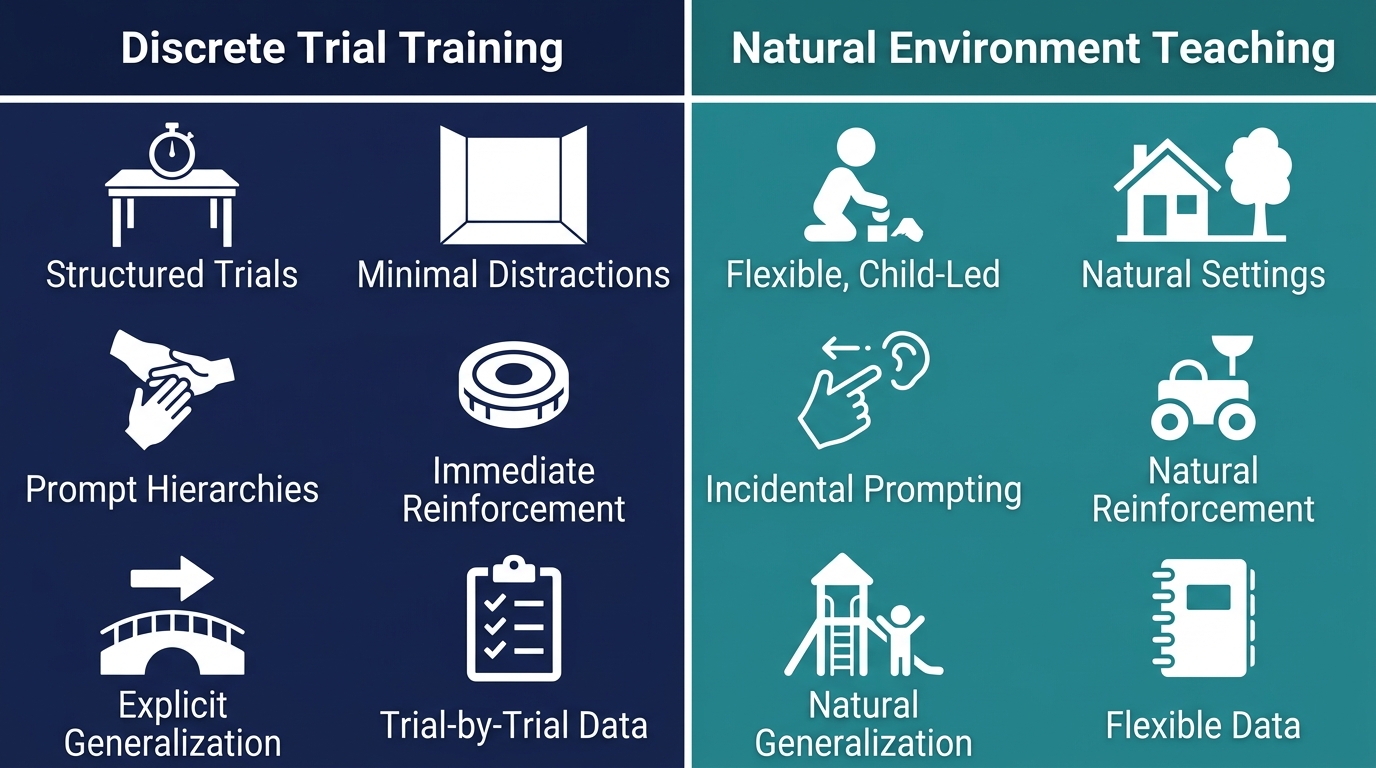
DTT vs NET: Structured trials compared with child-led learning
Techniques and Applications of Discrete Trial Training
Discrete trial training is a core technique we use to teach new skills to children with autism. Our ABA therapy for kids near me integrates DTT for communication, social, and academic development. This section covers the ABC structure, prompting, reinforcement, and error correction that make DTT effective across our service areas in New Jersey, North Carolina, Arizona, Colorado, and Utah.
We often compare DTT with Verbal Behavior Therapy to help families choose the best approach. The table below highlights key differences.
| Dimension | Discrete Trial Training (DTT) | Verbal Behavior Therapy (VB) |
|---|---|---|
| Focus | Teaches simple and complex skills in a controlled, step-by-step format | Emphasizes the function of language (mand, tact, echoic, intraverbal) |
| Teaching Method | Massed trials of the same target until mastery, then rotation | Natural, distributed trials embedded throughout the session |
| Reinforcement | Delivered after each correct response, often edible or token | Reinforcement is directly related to the response (e.g., giving a cookie after asking for it) |
| Target Skills | Any academic, motor, self-help, or communication skill broken into discrete steps | Specifically targets verbal operants: requesting, labeling, repeating, and conversing |
DTT’s structured, trial-by-trial approach allows us to teach skills that can be broken into clear steps, making it especially effective for early learners and children who thrive on predictability. The process flow below illustrates how each discrete trial moves from instruction to reinforcement, ensuring consistent learning opportunities. This visual serves as a helpful reference for therapists and caregivers learning the DTT sequence.
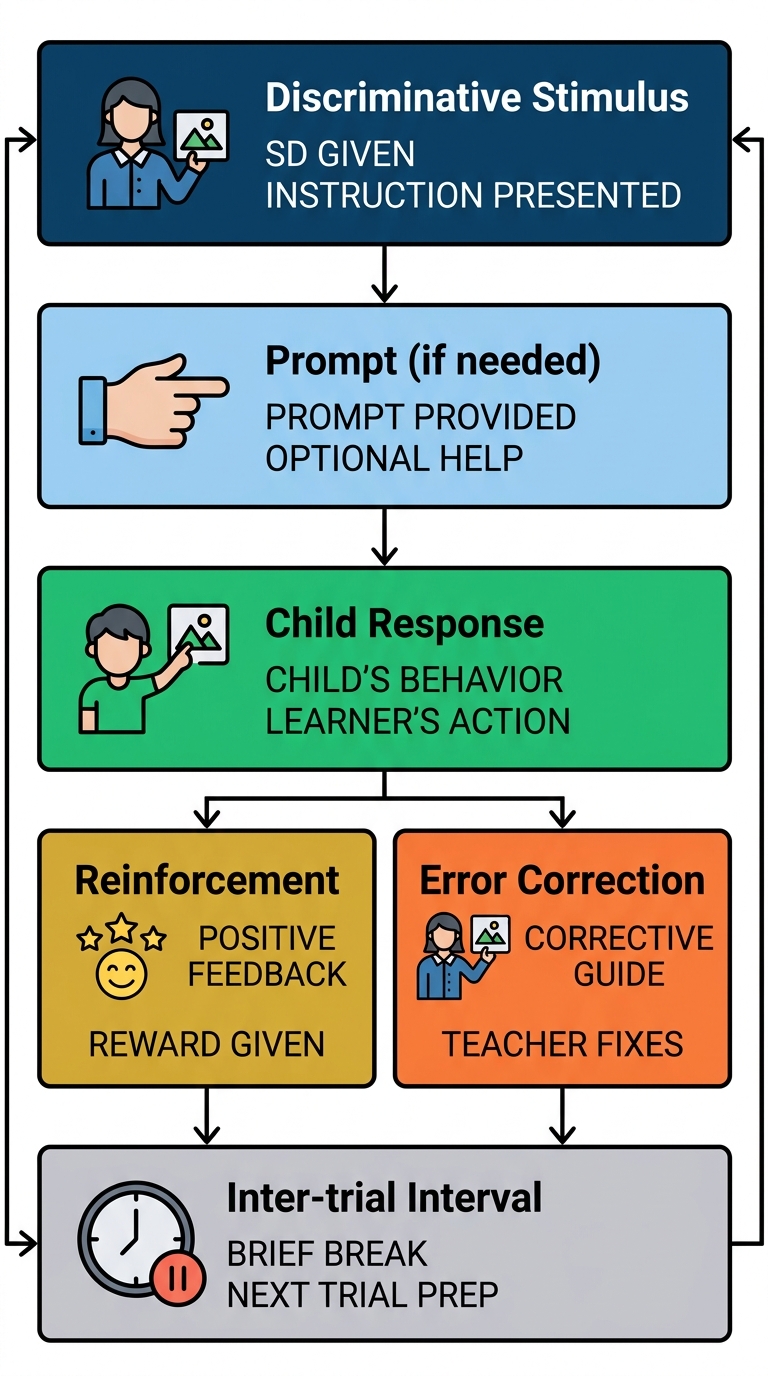
Discrete trial training process flow for ABA therapy education.
With this framework in mind, let’s examine the fundamental components that make up a discrete trial.
The Structure of a Discrete Trial: Antecedent, Behavior, Consequence
We begin every trial with a clear antecedent—such as presenting a picture of a cat and saying, “Point to the cat.” The child’s pointing is the behavior. If the child responds correctly, we immediately deliver a reinforcing consequence, like verbal praise or a token. If incorrect, we use an error correction procedure. The discriminative stimulus and any needed prompt set the stage for success. This three-term contingency ensures consistency and measurability, and we use data collection to track every response and guide decisions about skill mastery.
Prompting Strategies and Fading Techniques
We choose prompting strategies based on each child’s needs. In most-to-least prompting, we provide full physical guidance first, then fade to a light touch, gesture, and finally an independent response. Least-to-most prompting starts with a verbal cue and introduces more support only when necessary. Our RBTs deliver this prompting as part of rbt therapy, ensuring consistency across sessions. Systematic fading is critical to avoid prompt dependency and to build truly independent skills; we monitor prompt levels continuously and adjust based on performance data.
Reinforcement Schedules and Token Systems
We begin with continuous reinforcement, providing a reward after every correct trial. Once the child demonstrates consistent accuracy, we shift to an intermittent schedule—reinforcing every two to three correct responses—to build endurance. Token economies further motivate children: they earn tokens for correct trials and exchange them for a preferred activity or item. This system helps maintain motivation and teaches delayed gratification. We select reinforcers based on each child’s interests to keep sessions engaging and effective.
Error Correction and Trial Termination
When a child gives an incorrect response, we use a model-prompt-repeat correction: we model the correct answer, provide a prompt, and present the trial again. This immediate feedback helps the child learn the correct response without frustration. If the child makes three consecutive errors on a target, we simplify the demand or move to an alternative skill to maintain motivation. Our BCBAs guide these decisions based on ongoing data.
Although DTT is highly effective, results vary based on individual factors; always consult your BCBA before making changes to a treatment plan. This content is for educational purposes and is not a substitute for professional medical advice. Understanding these techniques prepares you to implement DTT across home, school, and clinic settings. Next, we’ll discuss how to tailor DTT to individual goals for even greater success.
Implementing Discrete Trial Training in Home and School Settings
Once you understand the core principles of discrete trial training, the next step is implementing them effectively across settings. At Hidden Gems ABA, we believe that a well-executed DTT program relies on precision, consistency, and a data-driven mindset—whether you are working at the kitchen table or in a resource room. Our personalized approach to treatment ensures that each learner’s plan is tailored to their unique strengths and needs, but the nuts and bolts of effective session delivery are universal. We will walk through the physical setup, the critical dos and don’ts of running trials, how to transform raw responses into actionable data, and finally, how to move skills from the teaching table to the real world.
Setting Up a DTT Session: Materials and Environment
A distraction-free environment is the bedrock of effective discrete trial instruction. We recommend a small table placed against a blank wall, away from windows, busy bulletin boards, or foot traffic. The therapist and child should be seated so that eye contact and attention are easy to maintain—typically side-by-side or facing each other. Before the learner arrives, gather your essential materials: a set of target stimulus cards for the day’s programs, a data sheet with a working pen, and a small bin of preferred reinforcers. These reinforcers might include small edible treats, sensory toys, or tokens for a token board. Having everything within arm’s reach minimizes downtime and keeps the learner’s focus on the instructional loop. This consistent setup, which is a cornerstone of our comprehensive and collaborative approach, builds predictability and reduces anxiety, allowing the child to attend fully to the learning tasks at hand.
Running Trials with Fidelity: Dos and Don’ts
Running a discrete trial training session with high fidelity means adhering to a specific rhythm. After presenting a clear and concise discriminative stimulus, wait 2–3 seconds for the child’s response. For every correct, unprompted response, deliver reinforcement immediately and briefly, keeping the inter-trial interval to 3–5 seconds before presenting the next instruction. This brisk pacing, a core element of rbt therapy fidelity, prevents off-task behavior and builds behavioral momentum.
To help maintain this standard, we recommend these concrete dos and don’ts:
Dos:
- Present the SD in a clear, consistent voice to ensure the learner always knows what is being asked.
- Wait 2–3 seconds for a response before providing a prompt, giving the learner a chance to answer independently.
- Use error correction by repeating the trial immediately with a prompt to ensure the correct response is practiced.
Don’ts:
- Do not allow the child to engage with off-task materials between trials, as this disrupts the instructional flow.
- Do not change the SD wording mid-session, as inconsistent instructions can confuse the learner and muddy your data.
- Do not skip data recording after every trial, as missing a single point can obscure a pattern of incorrect responding.
Collecting and Analyzing Data in DTT
Data collection transforms a series of trials into a clear story of the learner’s progress. For new acquisition targets, we rely on trial-by-trial data, recording each response as correct (+), incorrect (–), or prompted (P) immediately after it occurs. This granular approach, exemplified in the table below, lets a BCBA pinpoint exactly when a skill is emerging. For skills that have been previously mastered, probe data—taking the first unprompted trial of the day as a check—is a time-efficient method for assessing maintenance. A condensed session summary, which tallies the percentage of correct responses at the end of a block of trials, is useful for broader progress reports and when time is limited during a busy session.
| Method | Description | Advantages | Best Used When |
|---|---|---|---|
| Trial-by-Trial Data | Recording each trial's response (correct, incorrect, prompted) immediately after it occurs | Provides granular, moment-to-moment progress; easy to detect skill acquisition trends | Teaching new skills, tracking prompt levels, or when high precision is needed |
| Probe Data | Presenting a trial without prompts at the beginning of a session to see if the skill has maintained | Saves time, measures true independent responding, and assesses generalization | Assessing maintenance after mastery, conducting cold probes, or during review sessions |
| Session Summary Data | Recording the total number of correct trials or percentage correct at the end of the session | Quick to record, useful for session notes and billing, good for overall progress monitoring | Routine progress tracking, quarterly reviews, or when time is limited |
Choosing the right method depends on the purpose of your data. Use trial-by-trial recording when teaching fragile new skills, and shift to probe or session summary data once a learner demonstrates consistent accuracy, allowing you to focus your energy on running a smooth and engaging session.
Generalizing Skills Beyond the Training Table
The true measure of successful discrete trial training is not what a child can do at a table with a therapist, but what they can do independently in the bustle of daily life. To bridge this gap, we pair DTT with natural environment teaching by embedding mastered targets into routines. For example, a child who has mastered labeling colors with flashcards can practice the same skill while sorting laundry at home, and a student working on requesting can be prompted to ask for help during classroom circle time. This integration is essential for a well-rounded verbal behavior therapy approach, as it ensures functional communication is reinforced by natural consequences.
Parent and teacher involvement is the engine of generalization. We equip families and educators to run one or two trials in a natural context and report the outcome to the supervising BCBA. Teachers, in particular, can consult trusted special education teacher resources for classroom DTT strategies that align with a student’s IEP goals. This partnership ensures that learning is not confined to a single setting but becomes a durable, portable skill.
With a solid DTT implementation plan and generalization strategies in place, you are ready to explore more complex behavior-change procedures. Results may vary based on individual circumstances. Please consult with a healthcare professional or Board Certified Behavior Analyst (BCBA) for personalized advice.
Integrating Discrete Trial Training with Other ABA Methodologies
Discrete trial training (DTT) provides a highly structured framework for teaching new skills, but its true power emerges when combined with other ABA methodologies that promote skill generalization and functional application. At Hidden Gems ABA, we integrate DTT with Natural Environment Teaching, Verbal Behavior Therapy, and Social Skills Groups to create a balanced, comprehensive treatment plan. The following table outlines three key integration strategies we use to help children apply what they learn across everyday settings.
| Strategy | Description | Example | Best For |
|---|---|---|---|
| DTT + NET | Use discrete trials to teach a skill initially, then systematically practice it in natural contexts to promote generalization. | Teach a child to identify colors via DTT, then ask them to pick a red toy during playtime at the park. | Learners who need initial structure but struggle to use skills outside of the table. |
| DTT + Verbal Behavior | Use DTT to build fluent verbal operants (e.g., mands, tacts) while incorporating natural reinforcement and verbal behavior principles during trials. | Use DTT to teach the word 'cookie' using a picture card, then immediately provide the cookie as natural reinforcement. | Learners who need intensive teaching of communication skills and benefit from functional language practice. |
| DTT + Social Skills Groups | Pre-teach social skills (e.g., turn-taking, greetings) using DTT, then have the child practice those skills in a structured group setting with peers. | Practice taking turns using a visual cue in one-on-one DTT, then join a social skills group where children take turns during a board game. | Learners who require explicit instruction before they can successfully participate in group activities. |
Each of these integrated approaches is delivered by our team of Board Certified Behavior Analysts (BCBAs) and registered behavior technicians (RBTs), ensuring that RBT therapy sessions draw on multiple evidence-based strategies to maximize progress. By blending discrete trials with naturalistic and social learning opportunities, we help children transfer skills from the instructional table to real-world routines.
This combined methodology aligns with our comprehensive and collaborative approach, which can be further tailored for learners with co-occurring conditions such as ADHD. Hidden Gems ABA offers specialized ADHD therapy services that incorporate these integration frameworks, so every child’s treatment plan addresses their unique profile.
For families seeking ABA therapy in Spring, integrating DTT with other methodologies is a core part of our personalized approach to treatment. We believe this model best supports ABA Therapy For Your Child’s Success. Results may vary based on individual circumstances. Please consult with a Board Certified Behavior Analyst (BCBA) for personalized advice.
Frequently Asked Questions About Discrete Trial Training
Here we address common questions that arise when families first learn about Discrete Trial Training.
Q: What is discrete trial training? Discrete trial training is a structured ABA technique that breaks skills into antecedent-behavior-consequence trials. It uses reinforcement to teach communication and imitation.
Q: How is DTT used in ABA therapy? BCBAs design the trials, and RBTs deliver them in home or school sessions. This rbt therapy often integrates verbal behavior therapy techniques, using DTT to teach language skills like requesting and labeling.
Q: Is DTT only for children with autism? DTT is especially effective for individuals with autism, but it is a method that can benefit any learner needing structured, repeated practice.
Q: How does DTT relate to social skills groups? In our social skills groups, children practice turn-taking and conversation skills first taught through discrete trial training. This structured teaching builds fundamentals that generalize in peer interactions.
Understanding these basics helps you see how DTT fits into a comprehensive ABA plan.
Discrete Trial Training as a Foundation for Skill Development
One cornerstone of our ABA therapy involves building skills through discrete trial training (DTT). Used as a foundation for skill development, DTT breaks complex skills into small, teachable trials. During discrete trial training, each trial includes a clear prompt, the child’s response, and immediate reinforcement to encourage learning. This process builds foundational skills such as imitation, receptive identification, and following daily instructions.
BCBAs track trial-by-trial data to personalize instruction. In RBT therapy, our trained behavior technicians implement DTT under the close supervision of a BCBA. Verbal behavior therapy employs similar systematic teaching principles. DTT is central to our personalized approach to treatment, and together with other techniques, it forms our comprehensive and collaborative care model.


