
.avif)

.avif)


Table of Contents
BCBA Career Outlook: What to Expect in 2025 and Beyond
As ABA therapy continues to expand, the career outlook for BCBAs remains one of the strongest in the behavioral health field. Demand for a Board Certified Behavior Analyst is expected to stay robust through 2025 and beyond, driven by growing recognition of evidence-based interventions across home and school settings.
Several factors support continued bcba job growth. Expanded access to ABA services across multiple states, deeper integration of behavior analysis in school systems, and heightened awareness of skill-development supports for children with autism spectrum disorder are all fueling demand. As Hidden Gems ABA Therapy explains, the BCBA’s ability to design individualized, data-driven treatment plans and oversee RBTs makes the role indispensable in delivering consistent, high-quality care.
BCBA professionals in 2025 can expect to work in diverse environments: in-home ABA therapy, school-based programs, social skills groups, caregiver coaching, and clinical supervision roles. This variety not only strengthens the profession’s outlook but also lets practitioners match their setting to their strengths.
While compensation varies by region and experience, bcba salary trends remain competitive. Upward movement in earning potential for BCBAs reflects the specialized expertise required to lead effective behavior-analytic programs. That said, individual results may vary based on individual circumstances, so please consult with a healthcare professional or BCBA for personalized advice.
We at Hidden Gems ABA Therapy witness the impact of BCBA-led care daily. Our in-home and at-school ABA services place BCBAs at the center of collaborative treatment, where they apply data-driven strategies to help children build meaningful communication, social, and independence skills in the settings where they live and learn. As the field advances, the BCBA profession outlook stays bright for those committed to this rewarding career.
Foundations of the BCBA Job Market
While understanding the meaning of ABA therapy lays the foundation, the Board Certified Behavior Analyst (BCBA) is the clinical leader who brings it to life. A BCBA conducts comprehensive assessments, designs personalized, data-driven treatment plans, and supervises implementation to achieve lasting change. This expertise drives an exceptionally strong bcba career outlook, fueled by expanded insurance coverage, IDEA mandates for school-based services, and the growing preference for in-home care. Hospitals, too, are integrating BCBAs into multidisciplinary teams, broadening demand. Across the states we serve—New Jersey, North Carolina, Arizona, Colorado, and Utah—demand for skilled BCBAs mirrors national trends.
To understand how these drivers translate into job opportunities, the table below summarizes the BCBA career outlook by work setting. Drawing from BACB annual report data and Bureau of Labor Statistics projections, we highlight projected growth through 2030 across schools, clinics, in-home agencies, and hospitals. This data shows where the strongest demand lies and helps BCBA candidates and families alike plan for the future.
BCBA Career Outlook by Work Setting
| Work Setting | Projected Growth (2025-2030) | Key Drivers |
|---|---|---|
| Schools | High | IDEA mandates, inclusion programs |
| Clinics | Very High | Insurance expansion, early intervention funding |
| In-Home Agencies | High | Family preference for natural environment |
| Hospitals | Moderate | Multidisciplinary teams, comorbidity cases |
Each setting leverages the BCBA's clinical expertise, with in-home agencies and schools aligning particularly closely with our in-home & at-school ABA therapy model. Across New Jersey, North Carolina, Arizona, Colorado, and Utah, we see strong bcba job growth driven by family preference for natural-environment learning and the integration of ABA into school inclusion programs. Our comprehensive and collaborative approach—combining personalized treatment plans, caregiver training, and coordination with educators—delivers the personalized approach to treatment families expect. As clinics experience very high growth through early intervention funding and hospitals integrate behavior analysts into multidisciplinary teams, the overall demand for BCBAs continues to expand.
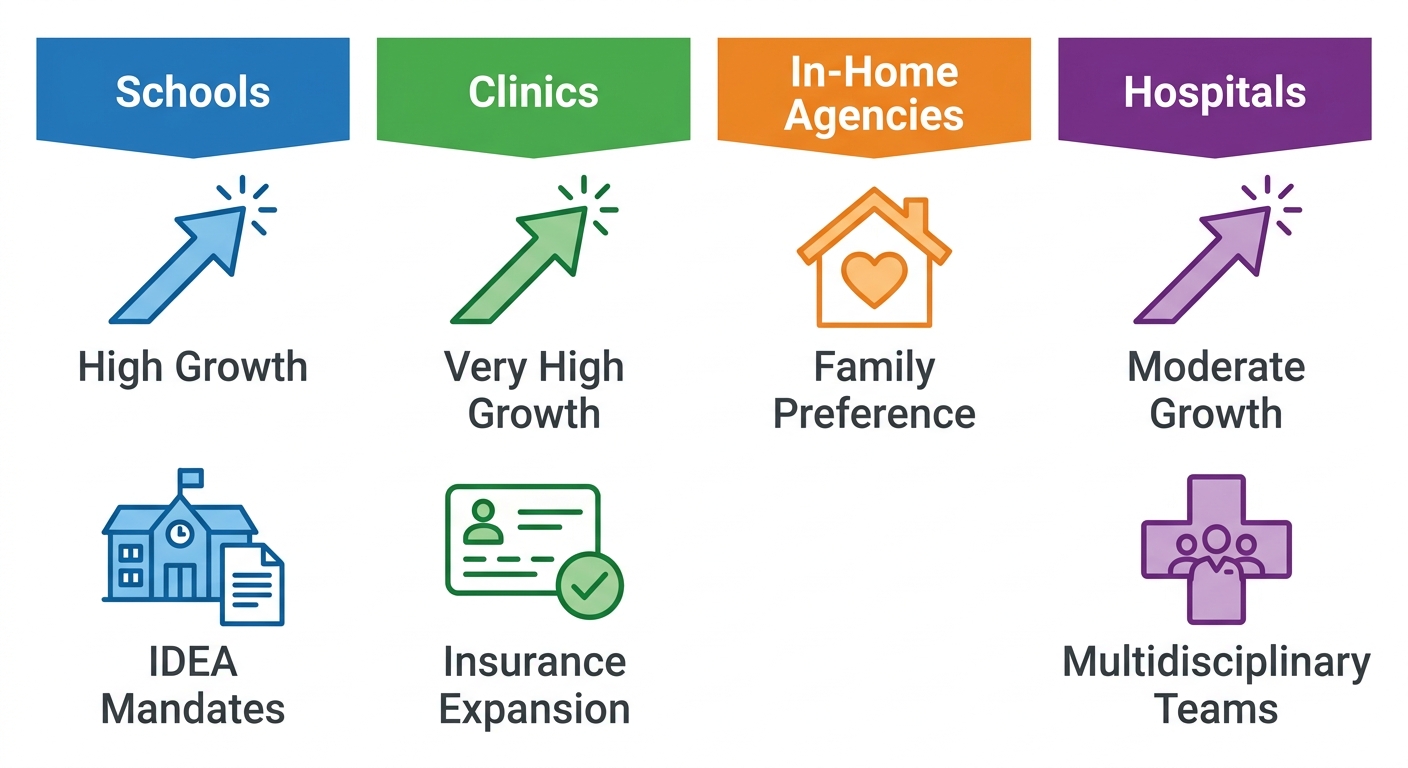
BCBA job settings growth trends through 2030
For those considering this profession, understanding the BCBA certification requirements is essential. The Behavior Analyst Certification Board (BACB) sets rigorous standards—a master’s degree, supervised fieldwork, and a national exam—that uphold the quality of care families depend on. This robust bcba job growth underscores the value of earning certification. While bcba salary trends continue to reflect increasing demand, entry into the field begins with meeting those qualifications. At Hidden Gems ABA, we believe that well-trained, certified BCBAs are the cornerstone of effective ABA Therapy For Your Child's Success. Understanding certification is the first step into this growing field.
Disclaimer: Information on this site is for educational purposes and is not a substitute for professional medical or behavioral-health advice. Results may vary based on individual circumstances. Please consult with a healthcare professional or Board Certified Behavior Analyst (BCBA) for personalized advice.
Salary Trends and State-Specific Opportunities for BCBAs
BCBA Salary Trends in 2025
The bcba career outlook continues to strengthen as demand for Board Certified Behavior Analysts rises across healthcare and education sectors. BCBA salary trends in 2025 reveal meaningful geographic variation, with earnings influenced by local economic conditions and the growing recognition of ABA therapy’s effectiveness. According to the Behavior Analyst Certification Board (BACB), the number of certificants has grown steadily year-over-year, reflecting an expanding credentialed workforce that supports this positive trajectory.
Several factors contribute to these salary differences. Years of experience play a major role, with seasoned BCBAs commanding higher compensation. Work setting also matters: clinicians in clinic-based roles may earn differently from those providing in-home & at-school ABA therapy. Additionally, cost of living heavily shapes state-level salaries — higher average salaries in states like New Jersey often correspond to elevated housing and living expenses, while lower salaries in Utah may be offset by more affordable costs. Understanding these financial trade-offs is essential for career planning.
The following table compares average BCBA salaries and demand across five states.
| State | Average Salary (USD) | Salary Range (10th-90th Percentile) | Job Demand Index |
|---|---|---|---|
| New Jersey | $85,000 | $70,000 – $105,000 | Very High |
| Texas | $78,000 | $62,000 – $98,000 | Very High |
| Colorado | $74,000 | $60,000 – $92,000 | High |
| North Carolina | $72,000 | $58,000 – $90,000 | High |
| Utah | $68,000 | $55,000 – $85,000 | Moderate |
These figures show that while New Jersey and Texas offer the highest average salaries, they also come with greater demand and typically higher living costs. Texas, in particular, benefits from a large population and expanding insurance coverage for ABA, which sustains both Very High demand and robust earnings potential. For BCBAs evaluating opportunities, comparing the Job Demand Index with salary ranges helps identify states where strong hiring demand may offset living expenses. Ultimately, career decisions should weigh personal priorities alongside these data-driven insights.
State-Specific Career Prospects for BCBAs
The bcba career outlook is notably positive in several key states. BCBA job growth is propelled by insurance mandates and school-based initiatives that expand access to ABA therapy. Below, we examine demand drivers in five states.
In New Jersey, robust insurance mandates for ABA therapy underpin Very High demand. The state’s coverage requirements have spurred a need for BCBA-led programs across homes, schools, and clinics, making it one of the top markets for behavior analysts.
In Texas, a large and growing population combined with expanding insurance coverage for ABA therapy creates Very High demand. School districts and private clinics continuously seek BCBAs to design and supervise behavioral interventions, contributing to the state’s robust hiring environment.
In North Carolina, High demand is fueled by robust school district partnerships integrating at-school ABA therapy. BCBA oversight is required for individualized education plans and RBT supervision, creating a steady need for behavior analysts in schools and in-home settings, making it a growing hub for the profession.
In Colorado, High demand is driven by expanding awareness and a supportive regulatory environment. Opportunities span metro and rural areas for in-home and school-based services, making it an attractive market for BCBAs across the state.
In Utah, Moderate demand still offers roles in school-based and private settings. The lower cost of living can appeal to BCBAs looking to maximize affordability while building stable, rewarding careers.
As BCBA demand rises, families seeking child ABA therapy services gain access to a larger, more experienced clinician workforce. This supports the comprehensive and collaborative BCBA-led model we provide — personalized treatment plans designed and supervised by BCBAs across our service areas. Salary figures are estimates; consult a healthcare professional or Board Certified Behavior Analyst (BCBA) for personalized guidance. This information is for educational purposes only and is not a substitute for professional medical or behavioral-health advice. See the HIPAA Notice of Privacy Practices on our website.
How to Launch Your BCBA Career: Certification and Beyond
Earning Your BCBA Certification: Requirements and Process
The BCBA career outlook remains bright as demand for behavior analysts continues to rise. To become certified, you need a qualifying master’s degree in ABA, psychology, education, or a related field, which must include a BACB-verified course sequence covering ethical and professional standards, behavior change procedures, and assessment techniques. After completing your degree, you must accrue supervised fieldwork hours—either 1,500–2,000 hours of standard supervised fieldwork or 750–1,000 hours of concentrated fieldwork under a BCBA; the concentrated track requires more frequent supervision contact to accelerate the process. Once fieldwork is documented, you apply for the BCBA exam through the BACB. The 160-question examination typically requires 3–6 months of preparation, and many candidates use study guides and practice tests. Additionally, some states, such as Texas, require separate licensure or endorsement beyond national certification; checking your state’s requirements early can prevent delays.
The following table outlines the four essential steps to BCBA certification, including typical timelines.
| Step | Description | Typical Duration |
|---|---|---|
| 1. Earn a Qualifying Master’s Degree | Complete a master’s program in ABA, psychology, or education that includes a BACB-verified course sequence | 2–3 years |
| 2. Accumulate Supervised Fieldwork | Complete 1,500–2,000 hours of supervised fieldwork under a BCBA, or 750–1,000 hours of concentrated supervised fieldwork | 1–2 years |
| 3. Pass the BCBA Certification Exam | Apply for the exam through BACB, prepare with study materials, and pass the 160-question examination | 3–6 months |
| 4. Maintain Certification | Renew certification every 2 years by completing 36 CEUs, including ethics and supervision requirements | Ongoing |
Many employers, including Hidden Gems ABA Therapy, provide supervision support and BCBA-led mentorship to help new certificants meet fieldwork requirements and build clinical confidence. This level of collaborative oversight ensures that new BCBAs develop the competencies needed to deliver effective, family-centered ABA services.
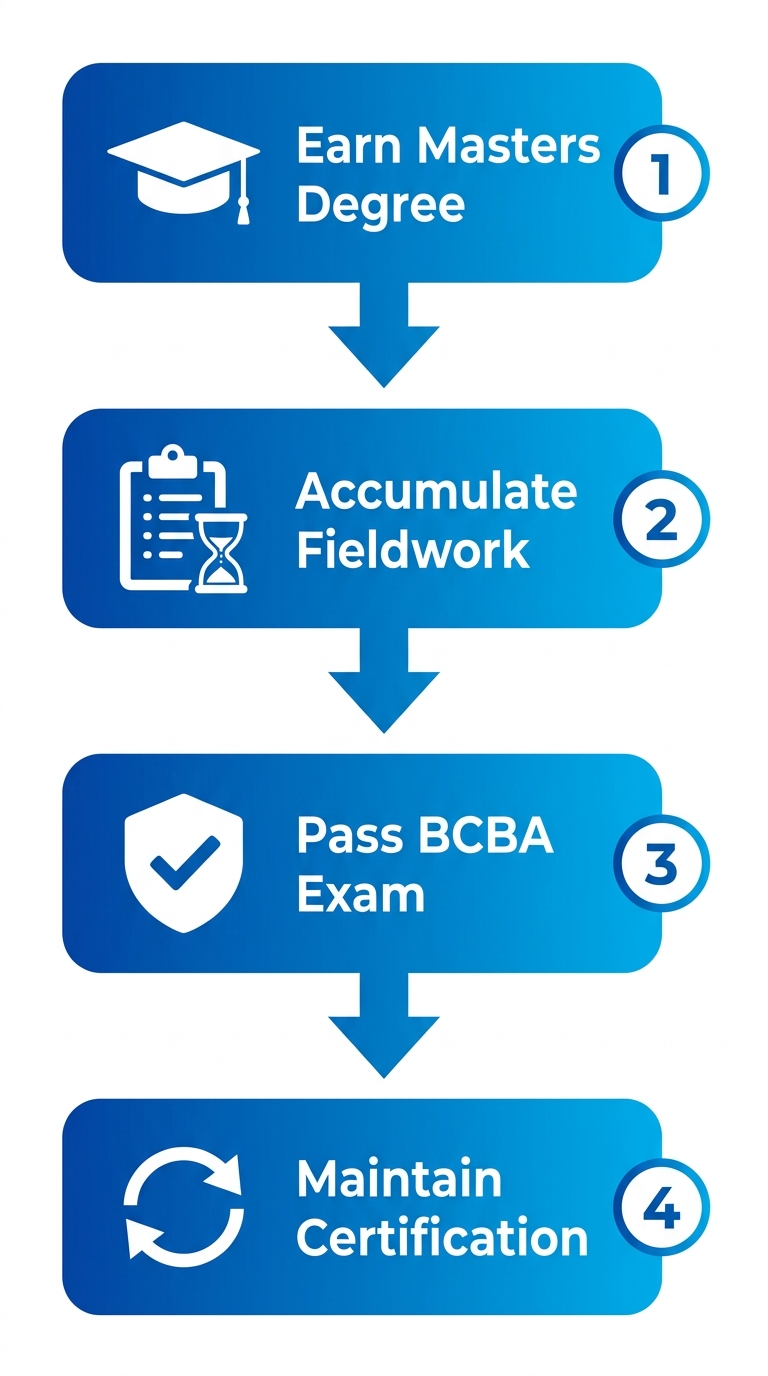
The BCBA certification pathway in four clear steps.
Finding Your First BCBA Job in ABA Therapy
Once you hold your BCBA certification, finding your first position is an exciting next step. When evaluating employers, look beyond the job description and assess supervision quality, caseload size, and organizational culture. Ask about the frequency and format of supervision, the availability of mentorship, and how the organization supports continuing education and professional development. Many new BCBAs begin their careers in in-home, school-based, or clinic settings; each offers distinct opportunities to apply your skills. At Hidden Gems ABA Therapy, we provide comprehensive BCBA-led oversight and a family-centered, data-driven environment that helps you build confidence and clinical expertise. Our collaborative model ensures that you receive consistent guidance while working with children and families in real-world settings.
To find the right fit, tap into professional networks. BACB communities, ABA professional groups, and university alumni networks are excellent sources for job leads and honest feedback about employer culture. These connections can also introduce you to seasoned BCBAs who offer career mentorship.
The BCBA career outlook is bolstered by strong salary trends and job growth projections. BCBA salary trends indicate competitive earning potential, and BCBA job growth is expected to remain well above average as demand for ABA services increases across the United States.
When you’re ready to explore local opportunities, searching for ABA therapy for kids near me can help you identify providers that align with your career goals.
Please note: Results may vary based on individual circumstances. Please consult with a healthcare professional or Board Certified Behavior Analyst (BCBA) for personalized advice. Information on this site is for educational purposes and is not a substitute for professional medical or behavioral-health advice.
Expanding Your Impact as a BCBA
Beyond direct clinical work, the bcba career outlook for experienced professionals is expanding into leadership, research, and consulting. With growing demand across the country, BCBAs in New Jersey, North Carolina, Arizona, Colorado, and Utah are discovering new ways to increase their influence.
Many BCBAs pursue advanced roles to broaden their impact, gain autonomy, and increase earning potential. This journey often combines additional credentials, leadership training, and business acumen. Gaining experience across diverse settings, such as in-home & at-school ABA therapy, builds crucial skills. At Hidden Gems ABA Therapy, we’ve seen that BCBAs who master naturalistic, play-based interventions and embrace emerging tools like AI-assisted data analysis position themselves for leadership. These competencies—honed in real-world clinical environments—prepare professionals for doctoral study, agency direction, academic research, or independent consulting.
A clear understanding of bcba salary trends and bcba job growth projections helps professionals make informed career moves. According to the BACB Annual Salary Survey and APBA compensation reports, BCBA demand continues to rise, fueling opportunities for those who invest in further education and specialized skills.
The following table outlines four advanced career paths, each blending advanced education, specialized experience, and business or leadership capabilities.
| Role | Additional Credentials Required | Typical Work Setting | Average Salary Increase vs. Standard BCBA |
|---|---|---|---|
| BCBA-D (Doctoral) | PhD or EdD in ABA or related field | University, research lab, hospital | +15–25% |
| Clinical Director | 5+ years experience, leadership training | ABA agency, large clinic | +20–30% |
| University Professor / Researcher | PhD, active research agenda | University, research institute | +10–20% |
| Independent Consultant | 10+ years experience, business skills | Self-employed, multiple contracts | +25–40% |
Ultimately, the right path depends on individual career goals, strengths, and preferred work setting. Whether you choose doctoral research, agency leadership, academia, or independent consulting, each avenue offers unique rewards. Please note that results vary based on individual circumstances and this content is educational only; consult a professional for personalized guidance. Hidden Gems ABA Therapy is committed to supporting BCBAs, helping them expand their impact while serving families in New Jersey, North Carolina, Arizona, Colorado, and Utah.
Quick Answers to Common BCBA Career Questions
We answer common questions about the bcba career outlook.
What is the BCBA career outlook? The bcba career outlook is positive as behavior analysis gains recognition across educational and clinical settings. This supports strong demand for BCBAs.
How strong is BCBA job growth? Bcba job growth is robust, driven by expanding need for evidence-based services. The BACB certifies BCBAs and sets globally recognized standards, strengthening the credential’s value.
What are current BCBA salary trends? Bcba salary trends show competitive, rewarding compensation for this expertise. While numbers vary, the field offers meaningful professional rewards.
What do BCBAs do at Hidden Gems? Our BCBAs assess, plan treatment, train caregivers, and oversee in-home & at-school ABA therapy. Contact us to start a personalized plan.
Information on this site is for educational purposes and is not a substitute for professional medical or behavioral-health advice; results may vary.
Your Next Steps Toward a Rewarding BCBA Career
The BCBA career outlook is exceptionally strong, with rising demand for qualified professionals. Sustained BCBA job growth across our service areas in New Jersey, North Carolina, Arizona, Colorado, and Utah creates many opportunities. BCBA salary trends continue to reflect the value placed on clinical expertise. Take your next step by pursuing BCBA certification through supervised fieldwork, seeking a provider offering BCBA supervision and oversight, and contacting Hidden Gems ABA—where our BCBAs supervise across New Jersey, North Carolina, Arizona, Colorado, and Utah—to explore open roles. We invite you to reach out through our homepage today.


